


INVENTOR’S MIND
A Love Letter to Raspet Flight Research Laboratory
How learning to build drones led to the ugliest airplane Honda ever built. The workshop that had no equal on earth — and the engineers from Japan who knew it.
This is not a technical post. It is a debt repaid.
I owe the Raspet Flight Research Laboratory at Mississippi State University more than I can document on a resume or quantify in a patent count. For over two years I mixed glues, trimmed plies, built molds, and assembled airplane parts on a daily basis — work that does not appear on a transcript but shaped everything that followed. What I can do is tell the truth about what happened there — truth that is not in their timeline, not in Honda's press materials, and not in any publication I have ever found.
Raspet did not just train me. It trained a generation of students — domestic and international — who arrived with textbooks and left with hands. We were engineers in training, and what we built at Raspet every day could not be taught from a page: the feel of a properly wetted ply, the patience a mold demands, the difference between a part that will hold and one that will not. That culture of hands-on expertise was not incidental to Raspet's reputation. It was the reason Honda came to Mississippi. Honda's engineers had done their homework and found something at Raspet that no other university in the world had built.
They did not stumble into Starkville. They chose it. And they told me exactly why.
What Raspet Actually Built
Dr. August Raspet arrived at Mississippi State College in 1949. His sailplane research and boundary layer discoveries put the United States at world leadership in motorless flight. That is the public story. The deeper story is what those decades of hands-on flight research produced: a culture and a capability that no institution with a bigger name had accumulated in the same form.
In 1965, Raspet flew the Marvel — the world’s first all-composite aircraft equipped with a turboprop. Designed, developed, and built at the Starkville airport. Not at any high-name institution in higher education. In Mississippi, by a team that believed the only way to learn what composite airframes could do was to build one and fly it.
Follow this link: to See the Raspet Flight Research Labortory’s History
That flight happened twenty-one years before Honda arrived. By the time Honda’s engineers walked into Raspet in 1986, they were walking into two decades of composite flight hardware experience that did not exist anywhere else on earth.
The elite institutions were teaching composite theory. Raspet had been flying composite aircraft since before most of their composite programs existed.
There is a difference between a university that studies flight and a laboratory that builds it. Raspet was the second kind. That distinction is everything.
Why Honda Chose Mississippi
I was a graduate student technician at Raspet in the mid-1980s, working on composite demonstration drones in the early days before drones became the future of military technology. I was eighteen months from graduation when Honda Research and Development Corporation arrived in 1986 to build a turbojet-powered all-composite aircraft. I joined the mixed team that began the work — approximately twenty people: Honda engineers, MSU professors, and graduate student technicians.
Honda’s engineers were direct about their decision. They had specifically not chosen the institutions whose names appear at the top of every aerospace ranking — the schools that generate the most publicity, attract the most prestigious faculty, and publish the most celebrated research.
They did not choose those institutions because those institutions teach theory. Raspet built aircraft.
The second reason was the Marvel. Honda’s team had studied the composite leadership record and found it at Raspet — not as a recent development, but as a twenty-year body of work rooted in actual flight hardware. The fabrication knowledge they needed was not in a journal paper. It was in the hands of the people who had been building composite structures at the Starkville airport since 1965.
The third reason was deliberate and strategic. Anti-Japanese import hostility was openly and aggressively present in the United States of the early 1980s. A Japanese company quietly advancing composite aviation technology at a high-profile institution would have been a press story. The same program, run by a small mixed team at a low-key research laboratory in Mississippi, was invisible.
Honda did not hide in Mississippi. They chose Mississippi because it was simultaneously the right place and the quiet place. Those two things were not in conflict. They were the same decision.
The recruiter who interviewed me after graduation looked at my resume and saw Mississippi. I looked back and saw exactly what Honda had seen — because Honda’s engineers had told me what they found there.
The Ugly Duckling and the First Pancake
Here is what the public record does not contain.
Before the Honda MH-02 — the aircraft that flew in 1993 and became the platform for the HondaJet — there was the MH-01. MH stands for Mississippi and Honda. Those initials were chosen deliberately. This was a joint program from the first day, rooted in a specific place and a specific partnership.
The MH-01 (also known as the MH01) was Honda’s first experimental aircraft, built in 1987 to 1988 to test composite materials and innovative aerodynamic concepts that later influenced the HondaJet. It was a modified Beechcraft Bonanza, fitted with a new composite wing and tail section.
The MH-01 was not a new airplane, it was learning platform and demonstrator. It began as an existing aluminum turboprop airframe onto which the mixed team systematically replaced structural components with composite equivalents, one subsystem at a time, working to Honda’s head designer blueprints.
Tail and elevator first. Main wing second. . Each subsystem was built, proof-tested, and flown before the team moved to the next.
I worked on the first phase. My contribution was specific and bounded: composite tail and elevator. We built them, loaded them with sandbags to proof-test the structural design, and when they passed, they went on the hybrid airframe and the hybrid flew. In December 1987 I graduated and left for industry. The team kept building.
Honda does not host photographs of the MH-01. This is understandable. The aircraft was not beautiful. It was an aluminum airplane wearing composite parts it had not been designed for, still carrying its original turboprop because Honda had not yet solved above-wing engine placement. It looked exactly like what it was: a working prototype, a sandbag-tested proof of concept, a first attempt made by twenty people who were inventing the process as they executed it.
Every great program has a first pancake. The first one is always ugly. It is also the one that proves the pan is hot and the batter works. Without it, there is no breakfast. The MH-01 was the first pancake. The MH-02 was the breakfast that fed an industry.
By the time the MH-02 was designed and built from scratch, that mixed team had collectively manufactured and flight-tested every major composite structural element of a jet aircraft. The knowledge was not theoretical. It was in their hands. It was Raspet’s gift to Honda, and Honda’s gift to aviation.
What This Story Is Not
I want to be precise about my role because the precision is the point.
I was a technician, not an engineer. I worked on one subsystem on a twenty-person mixed team that included Honda’s professional engineers and MSU faculty. My contribution was real, early, and specific. It was not central to the program’s success, and overstating it would dishonor the engineers, professors, and fellow graduate students who carried the work forward after December 1987.
What the drone work gave me was preparation I could not have gotten from a classroom. Building real composite airframes — structures that had to hold together under load and in flight — before I ever worked beside Honda’s engineers meant I arrived at the MH-01 program with hands that already knew the material. That preparation was Raspet’s doing. The drone program was where Raspet taught me to build. Honda was where I understood why it mattered.
What I will not leave ambiguous is this: Raspet’s composite capability was not a happy accident. It was built over decades by people who believed that the only way to know if a composite airframe could fly was to build one and find out. That philosophy — the workshop over the whiteboard, the airframe over the abstract — is exactly what Honda came looking for. It is exactly what they found. And it is exactly what produced the world’s first all-composite experimental business jet from a research laboratory in Starkville, Mississippi.
The Love Letter
The American Institute of Aeronautics and Astronautics gave Raspet its Piper General Aviation Award in 1998 for fifty years of outstanding contributions to general aviation. The National Soaring Museum designated it a National Landmark of Soaring in 2003. Today it operates the largest unmanned aircraft fleet at any U.S. academic institution and serves as the FAA’s designated UAS Safety Research Facility.
None of that came from a ranking. None of it came from a marketing budget or an alumni endowment or a famous name above the door. It came from a culture that measured itself by what flew and what held together under load, not by what published and what impressed.
I cannot send Raspet a check. What I can send is this: a public statement, by someone who was there, that what happened in Starkville in the mid-1980s was not a footnote to aviation history. It was a chapter. The Honda MH-01 was the first pancake, ugly and unphotoable and essential. The MH-02 was the proof. The HondaJet, still in production today, is the legacy.
Raspet’s hands are in that airplane. The hands of professors and engineers and graduate student technicians who stacked sandbags on composite tail surfaces and then watched them fly.
To the faculty, staff, students, and researchers of the Raspet Flight Research Laboratory — past and present — you built something the theorists only described. Aviation knows what you did, even when aviation forgets to say so. I am saying so now.
That is the love letter I owe you. Seventy-five years of advancing aviation, and the work was always real.
Today, in 2026, Raspet is still leading. The largest unmanned aircraft fleet at any U.S. academic institution. The FAA’s designated UAS Safety Research Facility. Firsts still accumulating, the same way they always did — not by announcing ambition but by doing the work. The hands-on culture that trained a generation of composite engineers is now training the engineers who will define what aviation becomes next.
Learn more about Raspet: Visit the Raspet Flight Research Labortory
Attached is the summsry of the SAE paper submitted by the RFRL staff and MSU professors on the MH-01 prototype design and fabrication.

This is not the MH-01 it’s the …
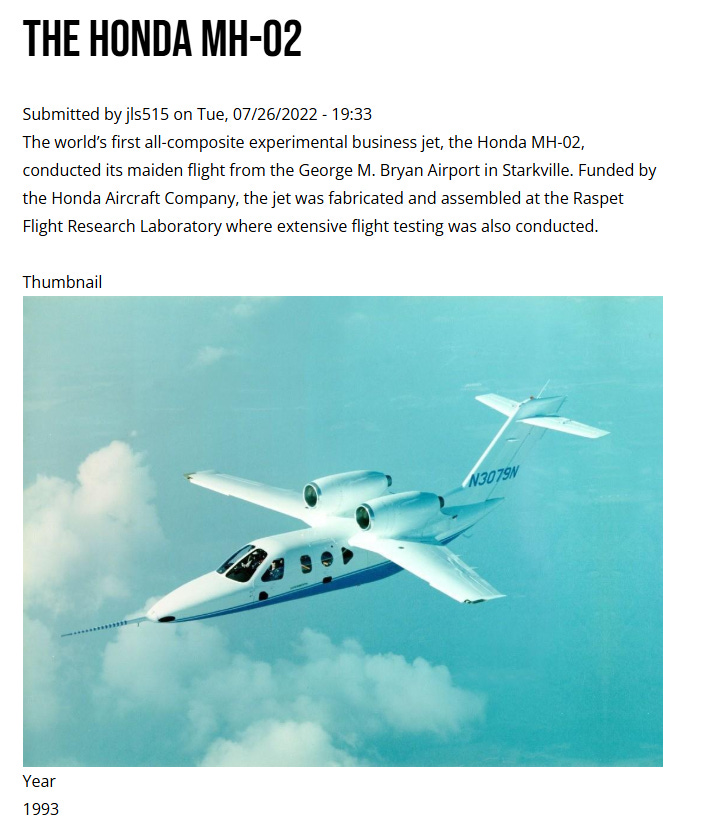
Note: The image shown in this article is the Honda MH-02, it is the second prototype that Honda Produced. Images of the MH-01 are rare, and after much seraching, apparently not available in my internet searches. (I do not own this image and will remove it upon request.)
Learn more about the MH-02 at: https://en.wikipedia.org/wiki/Honda_MH02
Learn more about the production Honda Jet at: https://www.hondajet.com/
I am Herbert Roberts, P.E. — a licensed Professional Engineer with 32 years in aviation research and development, 62 patents, and 8 years translating engineering failures into legal outcomes for attorneys. If you are working in composite structures, patent strategy for materials innovation, or trying to understand where a hands-on capability fits in a commercial landscape, I want to hear from you.
Tell me what you are building.
inventorsmindblog.com
© Herbert Roberts, P.E. | Inventor’s Mind | All rights reserved