

I came up building things meant to be fast. Race fabrication, machine work, the whole religion of more power and less weight. When you spend your early years in that world, you absorb a quiet assumption you don’t even notice you’re carrying: that the impressive machine is the one built for speed, and everything else is just transportation. The Ferrari is the achievement. The grocery-getter is what you settle for.
It took me a long time, and a lot of failures that had nothing to do with horsepower, to understand that the assumption is backwards. The hardest engineering problem in any room is almost never “make it faster.” It’s “make it do the boring thing better than anyone thought the boring thing could be done.” And the single cleanest proof of that I know of is a vehicle nobody ever taped to their bedroom wall.
So let’s do an autopsy on the minivan. Because the popular story about it is wrong in a way that’s actually more useful than the truth people think they know.
The legend, and the correction
Here’s the version most people carry: Lee Iacocca took over a dying Chrysler, built the minivan because regular families needed it, and the minivan saved the company from bankruptcy. Clean. Heroic. The right question saved the day.
I believed a version of that myself for years. Then I went back to the record, the way you’d go back to a failed part and actually section it instead of trusting the report, and the timeline doesn’t support the legend.
The thing that actually stopped Chrysler’s bleeding was not a vehicle anyone romanticizes. It was money and a sedan. The Chrysler Loan Guarantee Act passed Congress in 1979 and was signed into law in January 1980 — the federal government didn’t hand Chrysler cash, it co-signed the loans so private banks would lend to a company they otherwise considered dead. That bought time. What turned the time into survival was the K-car — the Dodge Aries and Plymouth Reliant, plain front-wheel-drive sedans that arrived in 1981 and sold in the volume Chrysler desperately needed.
And here’s the detail that kills the legend cleanly: Chrysler repaid those federally guaranteed loans in 1983 — roughly seven years ahead of schedule — before the minivan ever went on sale.
The first minivans, the Dodge Caravan and Plymouth Voyager, arrived in late 1983 as 1984 models. By then the emergency was already over. So the minivan didn’t pull Chrysler back from the brink. The brink was behind them.
That sounds like it weakens the story. It does the opposite. The minivan’s real job wasn’t the rescue — it was building the durable, high-margin profit franchise that made the comeback permanent and defined what Chrysler was for the next twenty years. The loan guarantee was a tourniquet. The K-car was a transfusion. The minivan was the new heart they grew afterward. A tourniquet keeps you alive for an afternoon. A franchise feeds you for a generation. The second thing is the bigger achievement, and the legend robs the minivan of credit by handing it the wrong medal.
The part nobody tells you: Ford had it first, and threw it away
Now the detail that turns this from a business anecdote into a forensic case.
The minivan concept didn’t originate at desperate little Chrysler. It was developed years earlier at Ford — by an engineer named Hal Sperlich, who had a packaging idea for a small, tall, family-friendly people-mover. Ford killed it. The company was busy and profitable selling Mustangs and trucks, and a tall box for hauling kids did not fit the picture of what a winning car company made.
Sperlich got pushed out of Ford. So, separately, did Iacocca — fired by Henry Ford II in 1978. Both men landed at Chrysler, the one company sick enough to be interested in an idea a healthy company had no appetite for.
Read that carefully, because the Finger Test matters here: the failure wasn’t a stupid person. The people involved were excellent. The failure was a condition. A company doing well on muscle cars and trucks had no organizational reason to fund the unglamorous answer — its success was exactly what made it blind. The decision to kill the concept was rational inside Ford’s situation. That’s what makes it dangerous. It wasn’t a blunder anyone could point at in the moment. It was a profitable company doing the sensible thing and walking right past the future.
The idea didn’t win because someone was smart. It won because it finally reached someone desperate enough to build it.
The teardown: what the minivan actually solved
Here’s where I want to slow down, because this is the part that gets waved away as “marketing” when it was real engineering — the kind every working engineer should be able to read, and every non-engineer deserves to have shown to them plainly.
Strip the problem to its bones. A family needs to move several people and a pile of stuff — groceries, strollers, plywood, a soccer team — and they need to do it:
with car-like ride and handling, so it’s not a chore to drive every single day,
with a low, flat floor, so kids and cargo go in and out easily,
in something that parks like a car in a normal spot and a normal driveway, and
in something that fits in a standard home garage.
Now look at what existed before 1984, and watch each option fail a different requirement:
The station wagon drove like a car but was too low and too short — you couldn’t stand a kid up in it or stack much, and the third row was an afterthought facing backward.
The full-size van had the volume, but it was a truck. Body-on-frame, rear-wheel drive, a driveshaft running the length of the floor to a solid rear axle. That means a high floor, a truck’s stiff ride, a tall roof that scrapes the garage, and the turning circle of a small boat. Great for a contractor, punishing for a family.
The VW Microbus got the shape right and the spirit right, but it put the engine in the back and the driver’s shins in the front crumple zone, and it couldn’t get out of its own way on a highway on-ramp.
Every existing answer solved one axis of the problem by surrendering another. That’s the signature of a genuine engineering contradiction: you appear to be forced to trade interior volume against drivability, every single time. Want van space, accept truck penalties. Want car manners, accept car-sized space. Pick one.
The minivan refused the trade. Here’s the physical move that let it.
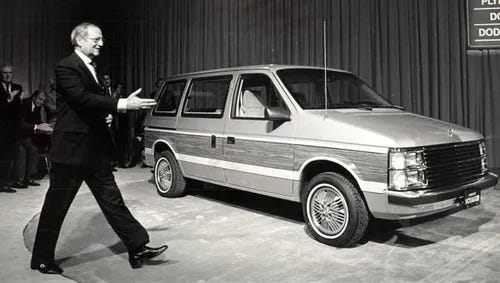
Lee A. Iacocca, then chairman of Chrysler Corporation, introduced the company's new breed of garageable 1984 front-wheel-drive family mini-vans
Front-wheel drive on a car-derived unibody platform. The minivan was built on the S platform, a stretched relative of the K-car. That one architectural choice cascades into everything:
Transverse engine, front-wheel drive. The engine sits sideways up front and drives the front wheels. There is no driveshaft running back to the rear axle — so there’s no tunnel humping up through the middle of the floor. That’s what makes the floor flat and low. A truck-based van can’t do this; its mechanical layout requires the hump and the height.
Unibody, not body-on-frame. The body is the structure, like a car, instead of a separate body bolted onto a truck frame. That gives you car ride, car weight, and a lower overall package.
A short nose and a tall, upright box behind it. Push the powertrain forward and flat, and almost the entire footprint becomes usable cabin. Maximum room inside, minimum size outside.
And the roofline was deliberately held to clear a standard garage door — somewhere around five-foot-four. This was a design constraint, on purpose. The whole value of the thing evaporates if the family can’t close the garage on it.
A sliding side door, so it opens fully in a tight parking space or a narrow driveway where a swinging door would bang the car beside it.
None of those decisions is flashy. Stacked together, they resolve the contradiction that had defeated every prior people-mover: van volume with car drivability, in a box that parks and garages like a sedan. In the language I’ll use publicly for this — TRIZ, the theory of inventive problem solving — that’s a textbook contradiction resolution. You don’t compromise the middle. You change the underlying structure so the trade-off you were told was iron simply stops applying.
That is the innovation. Not the silhouette. The silhouette was the consequence of the physics. And that distinction is the whole ballgame, because of what the competition did next.
The fast-followers copied the answer and missed the question
The minivan was an obvious hit. Ford and GM, the giants who’d had every resource Chrysler lacked, moved to answer it. And here is the most instructive failure in the entire story — more instructive than Ford killing Sperlich’s idea, because these companies were trying now and still got it wrong.
GM came first with the Astro and GMC Safari in 1985. Ford followed with the Aerostar in 1986. Both of them reached for what they already had on the shelf: rear-wheel-drive truck platforms.
They copied the box. They missed the reasoning. By building on truck bones, they re-imported every penalty the minivan had been engineered to escape — the driveshaft and solid rear axle put the floor back up high, the ride went stiff and trucky, the package got heavier and taller. They had looked at Chrysler’s success, seen “tall box that families buy,” and reproduced the shape without reproducing the physics that made the shape worth buying.
It took them the better part of a decade to actually catch up — meaning, to copy the question instead of the answer. Ford didn’t field a true front-wheel-drive minivan until the Windstar in 1995. GM’s first serious front-drive attempt, the plastic-bodied “dustbuster” APVs of 1990, flopped on styling and execution; they didn’t really land it until the Venture in 1997.
Sit with that gap. Chrysler shipped the right architecture in 1984. The two largest car companies in the country, with vastly deeper pockets, needed until roughly 1995–1997 to match it. Chrysler banked a ten-year head start — not because they had more money or more talent, but because they had understood why the thing worked, and the copiers only understood that it worked.
The forensic signature
So what’s the transferable lesson — the thing you carry off this autopsy and use on a problem that has nothing to do with cars?
It is tempting to land on “ask the right question and you’ll get the right answer.” It’s clean, it feels earned, and it’s the kind of line that survives precisely because it flatters the asker. But the record won’t hold it up. Ford asked questions. GM asked questions. Sperlich’s question was answered — at Ford — and then thrown in a drawer. The question was never the scarce thing.
Here’s the signature the evidence actually supports:
The right question is worthless until someone is desperate enough, or free enough, to build the answer nobody wants to be seen building.
Good questions are necessary. They are also cheap, common, and constantly ignored by competent people inside successful organizations — because those organizations are successful, which is exactly the condition that makes the boring answer look beneath them. The scarce ingredient is the willingness to fund and build the unglamorous answer, plus the means to do it cheaply enough to ship. Chrysler had all three at once: the desperation that opened the door, the borrowed engineer who’d already done the thinking, and a cheap K-car platform that made the boring answer buildable on a broke company’s budget.
The graveyard is full of people who asked exactly the right question and were buried anyway — too early, too poor, or too comfortable to build what they’d correctly identified. Asking is not the bottleneck. Building the thing nobody will admire you for is the bottleneck.
Aftermath, and where the pattern points next
What became of the minivan? It got eaten — and how it got eaten is itself a lesson.
The three-row crossover SUV swallowed the minivan’s lunch over the 2000s and 2010s. And notice what the crossover is, mechanically: it resolves the very same family-hauling contradiction — lots of seats and cargo, car-like to drive — but it layers on two things the minivan deliberately didn’t have. Ride height, for the commanding view and rough-road confidence, and image, the status the minivan never carried. The minivan had become a symbol of surrender to suburban adulthood. The crossover let buyers haul the same kids and groceries without feeling like they’d given up. Same physics problem, re-solved with status added back in.
That’s a TRIZ pattern in plain sight: a successful resolution gets out-competed not by reversing it, but by an evolution that keeps the function and adds the dimension the first solution left on the table.
So point the same forensic instrument forward — and the first thing it does is catch a mistake, which is the most honest way to use it.
The obvious forecast is “the future is the electric minivan.” It’s wrong, and it’s wrong in the exact way the Astro and Aerostar were wrong. Swapping a gas engine for an electric motor changes how the box is powered. It changes nothing about what the box frees the human from — and the powertrain was never the axis the minivan won on. Remember: the minivan ran the same ordinary gas engine as everything around it. Its breakthrough was orthogonal to fuel entirely. The flat floor a parent could reach across. The baby seat that went where the parent needed it instead of where the driveshaft allowed. A truck’s utility finally made usable by a family. Gas-to-electric touches none of that. It is a fuel swap wearing the old architecture, and calling it innovation is copying the answer while missing the question all over again.
So ask the minivan’s real question instead: what constraint on the person gets removed next? The minivan freed the parent from the rigid, truck-shaped cabin. The next vector frees them from a different constraint on the same trip — eyes on the road. That’s autonomy. Not a new way to power the box; a new thing the box lets the adult stop doing.
And here the everyman image does what no spec sheet can. The promise of the minivan was control over the cabin — where the kids sit, what you can carry, how the family travels. Complete that promise. Now the parent climbs into the back, buckles in next to the kids, and watches the movie with them while the car handles the road. The thing the minivan started — giving the parent command of the inside of the vehicle — finishes when the parent no longer has to surrender their attention to the outside of it. That is the minivan’s true heir. Same human vector, one constraint deeper.
But the forecast comes with a thump, because autonomy might not be the minivan in this story — it might be the Concorde. The minivan’s real test was never “is it advanced?” It was “can the everyman afford to own it and keep it in the garage?” It passed because a cheap K-car platform made it buildable on a broke company’s budget — affordable to own, not just to ride in. Measure today’s self-driving cars against that bar and they fail it: fleet-only, geofenced, expensive, nothing a family buys and parks in the driveway. Which lands autonomy in a place you’ll recognize from earlier in this very piece — it is Sperlich’s idea sitting in the drawer. Correct. Demonstrated. Waiting for whoever is desperate or free enough to make it cheap enough for the everyman to own.
My forecast, stated plainly so you can hold me to it: the future is not “EV versus autonomy,” because powertrain was never the axis — those are orthogonal questions, and the industry only bundles them because drive-by-wire happens to bolt onto an electric drivetrain more cleanly. The real successor to the minivan is whichever constraint on the human gets removed next and made affordable enough to own. Autonomy is the strongest candidate, and it is stuck in the precise drawer the minivan got pulled out of. Whoever pulls it out — whoever makes eyes-off-the-road cheap enough for a family to buy and garage — banks the same ten-year head start Chrysler did. Not by asking a question no one could see. By building the answer everybody else found beneath them, or beyond them.
Where the two lineages meet
Trace the removals and you see one line, not two. The minivan took the human’s hands off the cargo problem — where the kids sit, what you carry, how a family fits. The self-driving car takes the human’s hands off the control problem — the road itself. Stack those two removals on the same box and you get what’s coming: a minivan that handles its own driving. A box that carries the family and steers itself.
But the two lineages meet from opposite intentions, and the difference is the whole ballgame for whether people accept it. The drone removed the human to send a machine where a person couldn’t or shouldn’t go — too far, too dull, too dangerous. That is removal for the human’s absence. The family vehicle removes the driver while the human is still aboard and wants to be — it is removal for the human’s presence. One lineage was built so the person wouldn’t be there. The other is built so the person can be there better — turned around in the seat, watching the movie with the kids, attention finally handed back. Same eyes-off-the-road technology. Opposite reasons for building it. The entire public fight over the autonomous family car lives inside that distinction, and anyone who blurs it loses the room.
The personal turn
I have watched this exact substitution coming for forty years, from the wrong end of it.
In 1985 I was at the Raspet Flight Research Laboratory building manually-controlled composite drones — boxes that flew, with a human still working the sticks. You cannot build that machine, feel how it wants to fly itself, and not understand that the human pilot’s days were numbered. The control was going to come out of the person’s hands. I knew it standing on the field, two decades before the autonomous military drone showed up to prove it.
What I did not see until I went back through this minivan story is that the same clock was running on the family car the whole time. The minivan’s driver was on borrowed time from the day the box was good enough to deserve a better steward than a distracted parent fighting traffic. The full realization of what a minivan is for — total command of how a family travels — was never going to stop at the cargo. It was always going to come for the driving too.
Could Iacocca have hit the grand slam in one swing — shipped the self-driving minivan in 1983 and skipped a tier? No. And that’s not a knock on him; it’s the rule the whole story runs on. The technology to fly the box itself did not exist yet. He hit the only pitch the decade threw him, and he hit it out of the park — the right answer for the constraints that were actually on the field. He took the first step and let it become his signature, which is exactly what a first step is supposed to do. The grand slam was always a different at-bat, in a different decade, for whoever’s standing at the plate when the technology finally arrives in the strike zone. If Iacocca were here today, that’s the tier he’d be reaching for — not a re-powered box, but the box that no longer needs you to drive it. The dronified minivan. The next step up the same staircase he started climbing.
The fastest Ferrari in the world is a magnificent machine. It has never once been the most important vehicle of its decade. The most important one is the box nobody wanted to be seen building — and the next most important one won’t be the one that drives fastest either. It’ll be the one that doesn’t need you to drive at all, so you can finally turn around and watch the movie with the kids.
— Inventor’s Mind