


Can You Spot the Next Big Thing?
What Every Business Leader and Young Engineer
Needs to Know About Evaluating Innovation
Here is the uncomfortable truth about most business education: it teaches you to evaluate markets but not technology.
You can build a discounted cash flow model in your sleep. You can size a TAM, segment a SAM, and calculate a SOM with your eyes closed. You can pitch a board, negotiate a term sheet, and build a go-to-market strategy that would make your MBA professors weep with pride.
But when someone puts an actual innovation in front of you — a working prototype, a patent portfolio, a sensor that does something no sensor has done before — can you tell whether it is real?
Can you tell whether the technology actually works, whether it will still work outside the lab, whether the claims are protectable, whether the manufacturing path exists, whether the regulatory timeline is realistic? Can you tell the difference between a genuine breakthrough and a polished demo that will evaporate the moment it meets real-world conditions?
Most business leaders cannot. Most young engineers cannot either, because engineering school teaches you to build things, not to evaluate whether someone else’s thing is worth building further.
This gap is expensive.
It leads to investments in technologies that cannot scale. It leads to partnerships with inventors who cannot deliver. It leads to strategic plans built on assumptions that any experienced engineer could falsify in ten minutes. Equally, it leads to the opposite error: dismissing genuinely transformative innovations because the evaluator lacked the vocabulary to understand what they were looking at.
I have been on both sides of this gap. Thirty-two years in aviation R&D taught me to build. Eight years in forensic engineering taught me to diagnose. Both careers taught me the same lesson: the ability to evaluate technology is a skill, and like any skill, it can be learned.
Today I want to give you two tools. Not frameworks. Not theories. Tools. Things you can use the next time someone puts an innovation on your desk and asks for your money, your time, or your championship.
Tool 1: The Megatrend Map
You do not need to understand how these technologies work. That is the engineer’s job. Your job is to understand that they are reshaping every industry simultaneously, and any innovation that ignores them is building on a foundation that is already shifting underneath it.
Eight technology megatrends are rewriting the rules of every market you will ever evaluate. When someone brings you an innovation, check it against this list. Not for how many it uses — but for whether it is aware of the ones that matter in its domain.
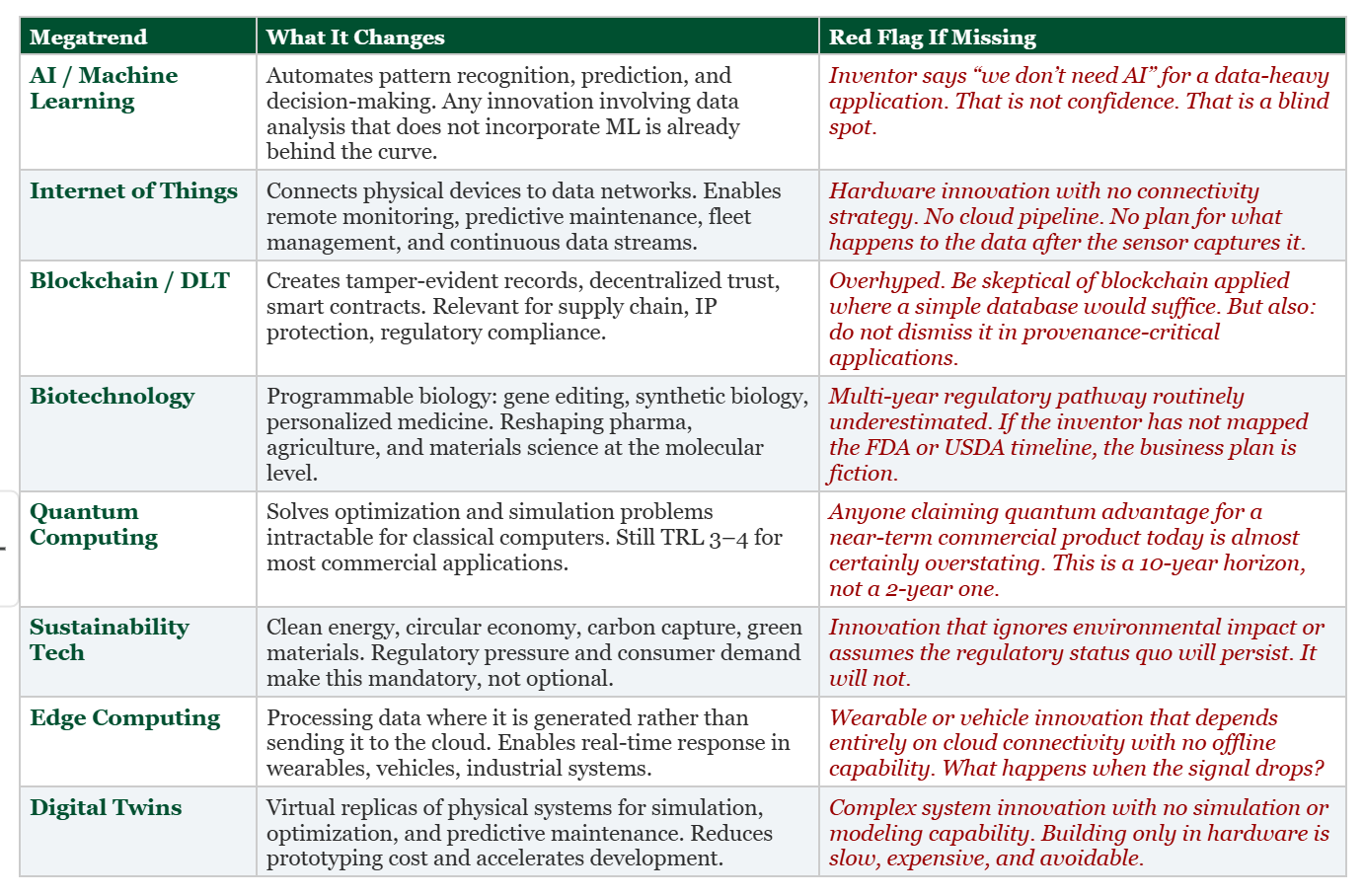
Notice what this table does not ask you to do. It does not ask you to understand transformer architectures, consensus algorithms, or CRISPR-Cas9 mechanisms. It asks you to look at the innovation on your desk and ask: is it aware of the forces that are reshaping its industry? Has the inventor thought about how AI changes the data layer? Has the inventor thought about what happens when connectivity fails? Has the inventor mapped the regulatory pathway?
If the answer to these questions is yes, the inventor is thinking systemically. If the answer is no, the inventor is building in a vacuum. Both answers are diagnostic. Neither requires you to be an engineer.
Tool 2: The First-Principles Test
This one is harder and more valuable.
Most innovations are described in terms of features. The sensor has six axes. The algorithm processes ten thousand data points per second. The material withstands twelve hundred degrees. Features are engineering language. They tell you what the thing does. They tell you nothing about whether the thing matters.
First-principles thinking strips the innovation down to its core value proposition. Not what it does. What it is for. The question is deceptively simple: what is the fundamental function this technology performs, and is there a simpler or cheaper way to perform it?
If the inventor cannot answer that question in one sentence without jargon, one of two things is true: the idea is too complex for its target market, or the inventor does not yet understand their own innovation. Both are disqualifying at this stage.
The One-Sentence Test
Every innovation should be expressible in the following structure. I call it the one-sentence test, and I use it on every idea that crosses my desk — including my own.
“This technology enables [specific user] to [specific action]
that they currently cannot do because [specific barrier],
resulting in [quantified benefit].”
Four blanks. If the inventor cannot fill in all four, they are not ready for market. Let me show you why each blank matters.
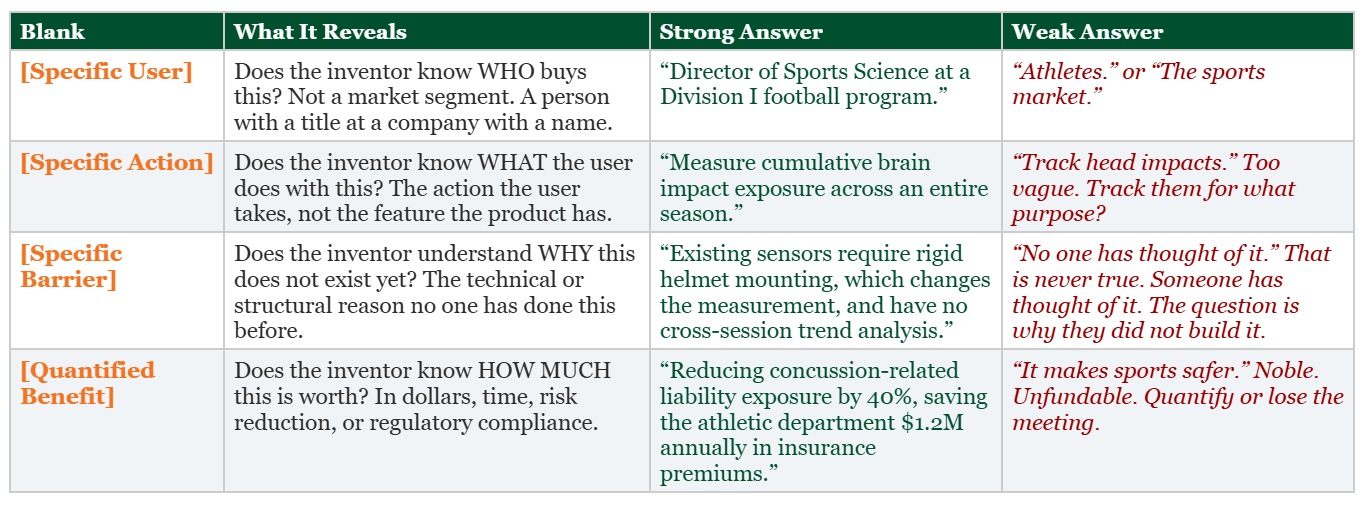
Here is the part that surprises people: this test is harder for the inventor than it is for the evaluator. The inventor has spent months or years deep inside the technology. They think in specifications. They dream in performance parameters. Asking them to compress all of that into one sentence is asking them to do something profoundly unnatural — to abandon the engineering details they love and speak in the language of the person writing the check.
The inventors who can do this are the ones who close deals. Not because the sentence is magic. Because the discipline required to write it forces the inventor to confront whether they actually know who their customer is, what the customer does with the technology, why the technology does not already exist, and what it is worth. Most inventors, when they sit down to fill in the four blanks, discover they can fill in two of them confidently and are guessing on the other two.
That discovery, made in your office rather than in a failed licensing meeting, is worth more than any financial model.
The Two-Minute Evaluation
You now have two tools. Here is how to use them together, in about two minutes, on any innovation that lands on your desk.
First: ask the inventor for the one sentence. If they cannot produce it on the spot, that is not a rejection. It is a diagnostic. Tell them to go write it and come back. The exercise itself will sharpen their thinking.
Second: scan the megatrend map. Which of the eight forces are relevant to this innovation’s domain? Has the inventor acknowledged them? Not used all of them — acknowledged them. An IoT sensor with no cloud strategy is a red flag. A biotech innovation with no regulatory timeline is a red flag. A data-intensive application with no AI layer is a red flag.
Third: trust what you have learned. If the sentence is clear and the megatrend awareness is present, you are looking at an inventor who thinks systemically. That does not guarantee the technology will succeed. It guarantees you are talking to someone worth spending more time with.
If the sentence is vague and the megatrend awareness is absent, you are looking at an inventor who is still inside their own head. They may have a brilliant technology. But they have not yet translated it into the language of the market, and until they do, no amount of financial modeling on your end will compensate for the lack of clarity on theirs.
The Skill That Pays for Itself
Evaluating innovation is not a talent. It is a skill. Like any skill, it improves with practice. The next ten innovations you see, run the one-sentence test and the megatrend scan. By the fifth one, you will start seeing patterns. By the tenth, you will feel the difference between an innovation that is ready for market and one that needs another six months of development before it deserves your attention.
That instinct — built through practice, not born from talent — is the single most valuable capability a business leader can develop in a technology-driven economy. It is the difference between the executive who says “I don’t understand the technology” and the executive who says “I understand enough to know this one is real.”
The first executive will always depend on someone else’s judgment. The second will make decisions that build companies.
Be the second one.
Not all new technology supports your business’s core mission. Some of it is genuine. Some of it is smoke in a slide deck.
The megatrend map is not a shopping list. It is a filter. The trends that matter are the ones that resolve a contradiction your customers have accepted as permanent. The trends that do not matter — no matter how impressive the demo, no matter how breathless the coverage — are the ones solving problems your customers do not have.
Here is your homework. It takes sixty seconds.
Look at that megatrend table one more time. Pick the one trend that keeps showing up in your inbox, your LinkedIn feed, your vendor pitches — the one everybody seems to be talking about. Now ask yourself: has that trend solved a single problem I actually have? Not a problem I might have someday. A problem I have right now, that costs me money or time or risk today.
If the answer is yes, you are looking at substance. Pay attention.
If the answer is no, you are looking at smoke. And that is fine — not every trend is for every business. The discipline is knowing the difference before you write the check.
Which trends are smoke for you? Tell us. Not to be cynical — to be precise. The best evaluators I have worked with in thirty-two years share one trait: they can articulate exactly why something does not fit as clearly as why something does.
That clarity is the skill. Build it with us.
Thanks for reading The Inventor’s Mind Blog’s Substack! Subscribe for free to receive new posts and support my work.
Herbert Roberts, PE, is a Licensed Professional Engineer with 32 years in aviation R&D, 62 patents, and over eight years of forensic engineering consulting for attorneys.
He publishes the Inventor’s Mind at inventorsmindblog.com