


The loss everyone remembers happened in 1971. The loss that actually mattered happened five years earlier — and the airplane it killed left a technology base still flying inside machines that never carried a single passenger.
The men in their fifties had a phrase for it. We lost the SST.
They said it the way you say a thing that decided your career before you understood it had. Not bitter, exactly. Settled. The way a man talks about weather that already happened to him.
I was in my mid-twenties when I first heard it, newly arrived at at an aerospace company in South Florida in the late 1980s, hired straight out of the pipeline of new engineers the company was bringing in by the dozen. The building I walked into was not one workforce. It was two, and they did not share a language.
The managers were in their fifties and older. They had spent twenty years designing the way they had always designed — detailed part and assembly drawings in pencil on vellum, laid out with T-squares and triangles; stress work done by hand, on graph paper, with Roark and Young’s formulas and Peterson’s stress-concentration factors, run through a hand calculator. That was not backwardness. It was mastery. These were people who could feel a load path the way a musician feels a key change.
The new engineers were in their early thirties, and we pushed the drawing boards against the wall. We wanted CAD. We wanted finite-element models, computational fluid dynamics, digital engine control wired into the airframe. IT ran on overtime standing up workstations on every new desk.
I spent years before I asked the obvious question: how did a building end up split down the middle like that, with a fault line running right through the age of fifty? And every time I asked, the answer came back in the same five words.
We lost the SST.
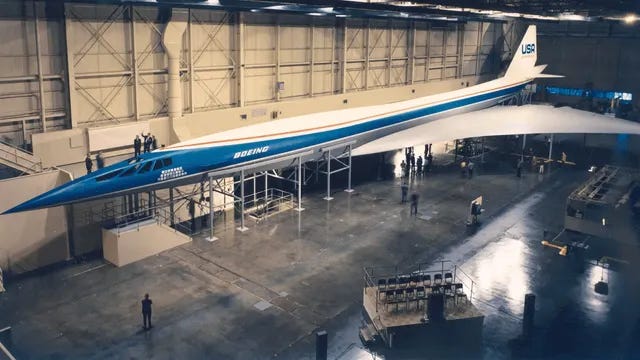
Boeing’s and GE’s SST
Here is my confession. For most of my career, I believed they meant 1971 — the year the United States Senate voted to cancel the American supersonic transport. That is the loss the history books record. It is the loss the headlines remember. The plane Congress killed.
I had it wrong. And I didn’t find out until I went back to the record myself.
Pratt did lose the SST. But not in 1971. They lost it in 1966, in the down-select — the competition to choose the engine. When that competition closed, General Electric’s GE4 — an afterburning turbojet derived from the YJ93 that powered the XB-70 — was chosen to power the Boeing 2707. Our entry, the JTF17 duct-burning turbofan, lost the race. The engine that would have carried Pratt into commercial supersonic flight was gone before the airframe ever reached the Senate floor. Gone not when Congress killed the program, but five years earlier, when the customer chose someone else.
So this is a story about two things: what was actually lost when the American SST died, and what became of all the technology the program generated after the airplane itself was gone. Because the airplane is the part almost everyone gets wrong.
The Airplane Was Never the Problem
The Boeing 2707 did not die because engineers failed to design an airplane. It died because Congress finally believed the economics and the physics — and the Concorde spent three decades proving that belief correct.
In 1971 the United States Senate voted to cancel the American supersonic transport program. Two years later, Concorde entered service. The irony is not that the cancellation was wrong. The irony is that the argument used to justify it was correct — and Concorde proved it over twenty-seven years of flying.
The American SST was not cancelled because it could not be built. It was cancelled because the mission specification and the operating environment contradicted each other in a way that no amount of titanium, afterburner thrust, or aerodynamic cleverness could fix. The airplane would have worked. The business case would not.
What the American SST Actually Was
The Boeing 2707 was the American entry in the race for commercial supersonic flight. The program began in 1963 with a federal commitment to fund development of a passenger aircraft that would cross the Atlantic faster than Concorde and do it at a lower cost per seat.
The policy objective was clear: leapfrog the Anglo-French Concorde and the Soviet Tu-144 with a larger, faster, more efficient airplane. The United States was not content to match Mach 2. It wanted more speed, more range, and airline-class economics.
The technical specification reflected that ambition:
Cruise speed: around Mach 2.7–3, compared to Concorde’s Mach 2 class.
Range: transatlantic and transpacific capability with reserves — targeting New York–London and Los Angeles–Tokyo nonstop.
Passenger capacity: on the order of 250–300 seats in early concepts, far larger than Concorde’s roughly 100-seat layout.
Structure: primary airframe in titanium or titanium alloys, because aerodynamic heating at Mach 2.7+ would push aluminum beyond its useful temperature limits.
This was not an incremental improvement over Concorde. It was a different problem. At Mach 2, an aluminum airframe survives the skin temperatures generated by sustained cruise. At Mach 2.7, those temperatures climb into a range that takes aluminum close to or past its allowable limits — especially once you factor in fatigue, creep, and safety margins. That drives you toward titanium and high-temperature alloys for large portions of the structure, bringing higher material cost, harder fabrication, and lower production rates.
The 2707 program changed shape as those realities came into focus. Early configurations featured a variable-geometry, or swing-wing, design. The swing wing would sweep back for supersonic cruise and forward for takeoff, landing, and subsonic flight, promising both high-speed efficiency and acceptable low-speed performance on existing runways.
On paper, the swing wing solved several aerodynamic problems. In practice, it created a structural one: weight.
A swing-wing system requires massive pivot structures, carry-through spars, and actuation mechanisms that can handle bending, torsion, and fatigue over the full life of the airplane. As the design matured, the weight of that system grew until the performance and payload margins began to erode. The airplane meant to be faster and more capable than Concorde risked becoming heavy, complex, and operationally marginal.
Boeing responded by abandoning the swing wing for a fixed delta — closer in spirit to Concorde’s ogival delta planform, but sized and shaped for higher speeds, different loads, and a different mission. The shift cut mechanical complexity and structural weight, but it did not shrink the ambition: Mach 2.7, transoceanic range, and airline-scale capacity on a titanium airframe.
With each design revision, cost estimates rose. Federal development funding continued, but the curves were diverging — technical difficulty bending upward, market justification bending downward.
By 1971, the estimated development cost had reached a level that, stacked against the projected market and operating constraints, the Senate could not justify. The vote to cancel was 51 to 46 — close, but decisive. The 2707 died on the floor of Congress, with mock-ups built and engineering well advanced, but with no flying prototype.
The engineers had not run out of ideas. The program ran out of economic credibility.
The Technical Contradiction the Market Exposed
The American SST carried a contradiction the program never resolved and Concorde spent thirty years underscoring.
Supersonic flight at Mach 2 and above generates a sonic boom — a moving shock-wave footprint that reaches the ground as a sharp, intrusive crack. Over populated areas, that boom is politically toxic and legally constrained. Communities do not accept windows rattled and structures shaken dozens of times a day by aircraft at cruise altitude.
Concorde hit this constraint immediately. It was permitted to fly supersonically only over ocean and unpopulated regions. For most routes that meant subsonic climb, acceleration to Mach 2 over the sea, supersonic cruise across the ocean, then deceleration back to subsonic before landfall. Its fast segment was literally bounded by coastlines and airspace rules.
The economics of commercial supersonic travel therefore depended almost entirely on transoceanic routes. New York–London, Paris–New York, Washington–London: a handful of city pairs where a few hundred passengers a day would pay a steep premium to arrive a few hours earlier. That is a small market, even for a national prestige project.
The 2707’s higher speed did not change the geometry. It operated under the same sonic-boom constraints — no routine supersonic flight over populated land, supersonic cruise confined to oceanic segments. Mach 2.7 did not open new airspace. It served the same ocean routes faster, at higher structural and propulsion cost, with a heavier airframe and a potentially lower payload fraction once all the titanium and thermal margins were counted.
Worse, pushing the cruise Mach number up pushed fuel consumption up with it. Supersonic drag rises sharply, and higher speed at altitude demands more thrust. At those speeds the specific fuel consumption of a turbojet — or a turbofan with afterburner — is far worse than a subsonic high-bypass turbofan. The American SST would have burned more fuel per seat-mile than subsonic jets, and likely more than Concorde per seat once its weight penalties were fully counted.
The contradiction was between the performance specification and the operating environment:
The faster you go, the stronger and more intrusive the boom.
The stronger the boom, the more restricted your overland operations.
The more restricted your territory, the smaller your potential market.
The smaller your market, the harder it is to amortize a large development program and high operating costs.
At some point, the marginal value of arriving even earlier — cutting a three-hour ocean crossing to two — does not justify the extra complexity, fuel, and ticket price required to fly Mach 2.7 instead of Mach 2. That point is where physics, regulation, and economics intersect. The Senate’s concern about economics was not a failure of imagination. It was a recognition that there was no realistic path for the American SST to pay for itself in the environment it had to operate in.
Concorde became the proof. Flying real passengers at real fares with real fuel bills, it operated for twenty-seven years with exceptionally high load factors on prestige routes — and still lost money or barely broke even for much of its life. It never recouped its development cost. It never triggered a second generation. The Senate’s economic fears were validated in metal and kerosene.
The Forensic Signature: A Supersystem Constraint Ignored
Here is the cut I make first whenever I take a failed program apart — and taking failures apart is literally my trade now, translating what broke into language a courtroom can use. Before asking how do we beat this limit, I ask where the limit lives: inside the system the engineers control, or in the supersystem above it. The two demand opposite responses. A constraint inside your system, you engineer through. A constraint in the supersystem — the atmosphere, the regulators, the route map, the public’s tolerance for noise — you design around, or you do not fly. No cleverness inside the box reaches a wall outside it.
That is the fourth Cancelled File signature: a program commits to a development path before resolving the contradiction that lives at the supersystem level — the physical constraint that makes the full mission impossible.
The American SST is almost a textbook case.
The engineering was sound. The airplane could have been built. Boeing and its partners understood the load cases, the aerodynamics, the propulsion, and the materials at a level that made a flying prototype plausible. Expensive, but not fantasy.
The mission was constrained by physics and policy in ways engineering could not overcome. Supersonic overland flight is a sonic-boom problem, and within a Mach 2+ specification you cannot engineer the boom away. You can shape it, spread it, soften its signature at the margins — but you cannot turn a Mach-2 shock wave into a benign whisper without changing either the flight regime or the rules. The supersystem — atmosphere, human tolerance, regulation, global route structure — imposed a hard limit: you may not routinely fly supersonically over land; you may only exploit your performance over oceans and empty country.
Given that constraint, the design space for a viable supersonic airliner narrows sharply. The airplane that fit that space in the 1960s was never a titanium Mach-2.7 transpacific flagship. It was something smaller, slower, less ambitious — a Concorde optimized ruthlessly for economics rather than national prestige. The program that accepted the constraint and designed within it might have produced a marginal but survivable niche airplane. The programs that ignored it — Concorde and the projected 2707 alike — built airplanes that confirmed the constraint was real. Concorde confirmed it by flying and losing money. The 2707 confirmed it by never getting past the appropriations committees.
What Survived: Technology Without the Airline
Cancellation did not erase the technology base the American SST created. In aerospace, hard-won knowledge almost never disappears. It migrates.
The capabilities developed for the SST — variable-geometry wing research, titanium high-speed airframe design, supersonic propulsion efficiency — transferred into the military and high-performance programs that needed exactly those skills:
Variable-geometry wings. The B-1 Lancer’s swing wing, and earlier variable-sweep aircraft like the F-111, drew on the same family of structural concepts and aerodynamic tools explored in the 2707’s early configurations. Designing pivot structures that carry supersonic loads and still move cleanly is not trivial; that expertise found a home in bombers and strike aircraft.
High-temperature structure and titanium fabrication. The need to build large, load-bearing titanium structures at scale — accounting for creep, fatigue, and thermal distortion — flowed into high-speed military airframes, reconnaissance platforms, and later advanced fighters. Titanium stopped being a boutique material and became a core part of the aerospace metals toolkit.
Supersonic propulsion efficiency. Work on intake design, nozzle shaping, afterburner integration, and high-Mach engine cycles deepened the understanding of how to pull thrust and efficiency from turbojets and low-bypass turbofans at speeds where inlet distortion, shock interactions, and high compressor-inlet temperatures turn serious. Those lessons fed both military engines and the civil designs that followed.
Even the environmental work — the noise, sonic-boom, and emissions studies — planted seeds. Today’s low-boom supersonic demonstrators and the current crop of supersonic business jets are built on data first collected in the wake of that first SST push.
For fifty years after that, the market constraint held exactly as the 2707’s cancellation predicted. Supersonic flight over land stayed banned. The market stayed locked to the oceans. And then — only in the last year — the wall finally began to move. Not because anyone built a faster airplane. Because someone changed the question.
The Prediction: You Don’t Beat the Boom, You Change What Gets Measured
Here is the forward move, and it is a textbook one for anyone who studies how constrained systems evolve: when you cannot defeat a constraint head-on, you stop attacking the constraint and start attacking the measure that enforces it. This is the most reliable engine of technical progress there is. The wall does not fall. The rule in front of it gets rewritten.
The 1973 regulation that grounded overland supersonic flight — the rule that made the 2707’s mission impossible — did not actually regulate noise. It regulated speed. It said: do not exceed Mach 1 over land, full stop. Speed was a convenient stand-in for the thing everyone actually cared about, which was a boom hitting the ground. The 2707 tried to win inside that rule by brute force — more thrust, more titanium, more Mach — and there was no winning, because the rule capped the exact variable the airplane was built to push.
Fifty years later, two things are happening at once, and together they relocate the entire problem.
First, the physics. In January 2025, Boom Supersonic’s XB-1 demonstrator broke the sound barrier over the California desert and produced no boom that reached the ground. It did this not by silencing the shock wave but by exploiting an old, well-understood effect called Mach cutoff: at a low enough supersonic speed — roughly Mach 1.1 to 1.3 — and a high enough altitude, the shock wave refracts as it passes from cold high air into warmer low air and bends upward before it ever lands. The boom still exists. It simply never touches the people below. The same atmosphere that made the SST’s boom intolerable becomes the thing that disposes of it. That is the move in its purest form: the constraint, turned into the solution.
Second, the rule. In June 2025 the FAA was directed to repeal the 1973 speed ban and replace it with a noise standard — measured where it was always the real issue, at the ground. Legislation to lock the same change into law has cleared committee, pushed partly by the argument that China’s manufacturers are chasing the identical capability. The proxy is being retired. The new rule, in effect, says: fly as fast as you like over land, as long as nothing audible reaches the people under you.
Put those two together and you can see the airplane coming — and it is the airplane this very teardown already named. Not the 2707. The smaller, slower, less ambitious machine I said earlier would be the only viable shape for the constraint. Boom’s Overture targets Mach 1.3 over land and Mach 1.7 over water, carrying not three hundred passengers but a few dozen. The market geometry the 2707 got wrong inverts: the overland routes, forbidden for half a century, open up — but only at the very bottom edge of supersonic, exactly where Mach cutoff lives. The future is not arriving as the SST’s titanium flagship. It is arriving as the airplane the SST’s failure described.
Now the caveat, because a forensic prediction states its own way of being wrong. The constraint has not vanished — it has been renegotiated, and the negotiation is not finished. Mach cutoff depends on weather: the refraction altitude shifts with the atmosphere, so the “boomless” speed cannot be fixed in advance and must be flown by software reading conditions in real time. There is a residual effect in the so-called shadow zone that the demonstrations have not fully closed out. Aerion, a company chasing this same loophole, went bankrupt in 2021 before it ever flew. And the FAA rule is still being written, not signed. The history of this exact constraint counsels humility: it has killed every program that underestimated it.
But the direction is set, and it is the direction the airplane’s ghost has been pointing the whole time. The SST was never wrong about supersonic travel. It was wrong about which supersonic airplane the world would permit — and it was a generation too early to change the rule instead of fighting it.
The engineering survived. The constraint survived. And now, fifty years on, the constraint is finally being met not with more speed, but with a better question.
The program ended in 1971. The loss that mattered happened in 1966. The physics is still flying — and it is about to fly over land.
The men who told me we lost the SST were right. They only had the year wrong — and so, for most of my career, did I. What none of us guessed was that the airplane would get its second chance the moment someone stopped trying to outrun the boom and started trying to outsmart it.
Herbert Roberts, P.E. spent 32 years in aviation R&D across two companies and has spent the last eight years analyzing accidents for attorneys under his PE license, translating engineering findings into legal language. Inventor’s Mind publishes every Tuesday, Wednesday, and Thursday at inventorsmindblog.com.