


The Autobahn Came to America and Became Something Else
I say this as someone who was formed by European transit before I ever sat behind a wheel.
The driving age was 18 in the countries where I came of age, which put a car years out of reach. What I had instead were streetcars, commuter buses, and national train networks — and those systems were not a consolation prize. They were freedom. A teenager without a license could still move: to the next town, the next country, the next stranger who had something worth hearing. The network did what no car could have done at that age. It handed me the continent.
I was old enough, in those years, to travel the European passenger network the way it was meant to be experienced. Rome to Denmark. Paris to Berlin. London to Edinburgh. It was fast, efficient, and human. You bought a ticket, found your compartment, and a few hours later stepped out into a different skyline, a different language, and a different set of strangers who did not stay strangers very long. The trains were not just transportation. They were social infrastructure. You met students, workers, families, and backpackers from cities you had never seen and countries you had barely learned on a map. You made travel friends because the system itself forced human proximity in motion.
In that environment, rail did not feel like an alternative. It felt like the backbone.
Then I came home to the US.
Too young to have gained a drivers license in Europe. Old enough for one in America. I got it quickly, bought a well-used car, and everything changed shape. What the train ticket had been in Europe — access to every inch of curiosity I could point myself at — the key in my pocket became here. I did not stop wanting to move. I stopped moving by timetable.
For years after that, I assumed America had simply failed to build what Europe had built. I had been formed in a place where streetcars and national rail were how functioning countries moved people. I read the roads as a choice made badly.
The geometry eventually corrected me.
In college I drove Interstate 10 between Jacksonville, Florida and Los Angeles, California three times. Later I drove I-95 from Miami, Florida to Bangor, Maine. Those trips felt nothing like Europe. Taking a train between those destinations was not even a thought. I did what every other American did. I merged onto the Interstate and drove. Different coasts. Different weather. Same logic. The roads were the system. The gas stations, truck stops, rest areas, cheap motels, and fast-food counters were the social infrastructure. In Europe, you met people in compartments and station cafés. In America, you met them at fuel pumps and Waffle Houses.
That contrast stayed with me because it explains more than most transportation arguments ever do.
The borrowed idea was real.
America looked at Germany’s Autobahn and saw exactly what any large industrial nation under pressure would have seen: speed, logistics, military mobility, and a road system that did not apologize for scale. The lesson was obvious. If a modern state wanted to move troops, freight, and civilians quickly, it needed more than patched local roads and a few old highways that wandered through courthouse squares and downtown stoplights. It needed a national system.
So we built one.
What most people miss is that we did not copy the Autobahn. We copied the proposition behind it and dropped that proposition onto a completely different map.
Germany was compact. The distances between major population centers were shorter. The density was different. The relationship between cities and rail was different. The United States was not a large version of that problem. It was a different problem entirely.
This matters because infrastructure is never just concrete or steel. Infrastructure is geometry with a budget attached.
If you have a country with a few dozen major cities, many of them relatively close together, a passenger rail backbone makes intuitive sense. You can run thick corridors between the main urban nodes, feed smaller communities into those corridors, and let the stations function as organizing spines for growth. The map helps you. The density helps you. The economics at least give you a fighting chance.
That was not the American map.
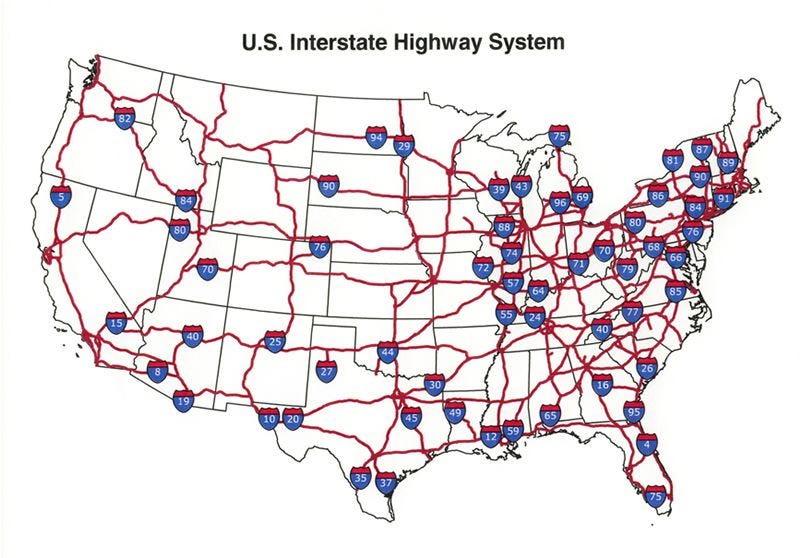
US Interstate Network
If the number is Even, then East-West travel.
If the number is odd, then North-South travel.
If an even number is in front of Interstate number then the road section is a loop, (will return to the main road)
If an odd number is in front of Interstate number then the road section is a spur, (will not return to the main road)
The United States had a continent to cover, a huge number of meaningful urban centers, and enormous empty spaces between many of them. Even where the land was not empty, it was often thinly distributed in a way that punishes fixed-route passenger systems. You could still build rail. Of course you could. We did build rail — a freight system so large it remains one of the biggest on earth. The question was never whether steel could cross the land. The question was whether a passenger system built in the image of Europe could serve American movement patterns as cheaply and as flexibly as roads.
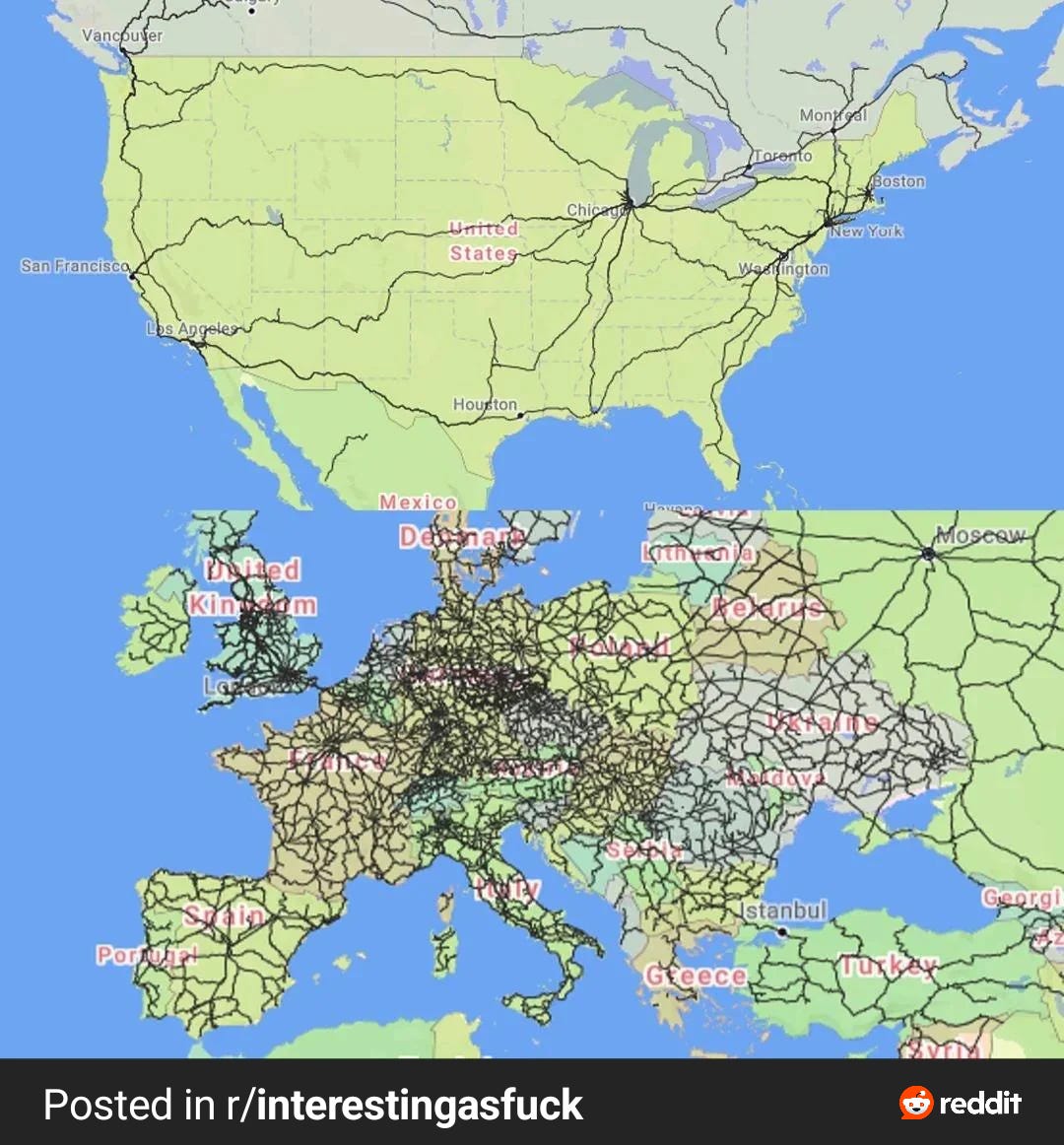
Passenger trains lines in US & Europe
The answer was no. Not because trains are bad. Because the map said no, and then the population said no, and then the politics said no.
A line on a map is not a transportation system.
The clean-line argument always skips this.
It draws a passenger loop from one major city to the next and stares at it until it begins to look inevitable. Connect the capitals. Connect the biggest city in each state. Connect the coasts. Connect the heartland. The line looks beautiful. The rendering looks civilized. The train in the artist’s concept image always arrives in perfect light and nobody in the station is carrying two screaming children and a cooler.
Then the real questions show up.
How many trains per day? One?
One train a day is not a substitute for a car. If a rail corridor is going to carry even a fraction of the travel that roads already carry, it needs frequency: morning, midday, evening, in both directions, minimum. That means six movements a day before you even start talking about peak demand, weekend travel, business schedules, missed connections, weather disruptions, special events, maintenance windows, crew rules, or the fact that Americans do not all travel between city centers at the same convenient hours.
The steel in the ground is only the first bill. The operating cost is the second bill. And the second bill never stops arriving.
This is where highways start to look less primitive and more intelligent.
A highway does not ask your permission to be useful. Once it is built, the scheduling problem gets pushed outward to the user. You supply the vehicle. You choose the departure time. You decide whether to stop for gas, coffee, or a motel. A commuter, a family of five, a truck driver, a National Guard convoy, and a contractor towing a backhoe can all use the same lane on the same day for completely different reasons. A rail line can be elegant. A highway is promiscuous. It serves almost everything.
That mattered in America more than people want to admit.
The numbering grid made that promiscuity legible. The east-west routes ending in zero and the north-south routes ending in five gave the country something passenger rail has never fully managed to offer at national scale: broad directional freedom from almost anywhere. If you lived in a state capital, a farm town, a suburb, a manufacturing city, or a place nobody in Washington had ever heard of, the Interstate system gave you a way to move north, south, east, or west without first detouring to a main passenger corridor, buying a ticket, matching a timetable, or changing trains in a hub that was never your destination to begin with.
That is not a small thing. That is the whole game.
Most American traffic is not a romantic long-distance trip between iconic downtowns. It is inside states, across metro areas, between suburbs and job sites, between warehouses and ports, from a small city to a larger one and back again by nightfall. Roads are good at this because roads do not require you to concentrate demand before movement becomes possible. They are coarse, wasteful, and magnificent at the same time.
Rail rewards density. Rail rewards concentration. Rail rewards stability. America kept rewarding dispersion.
Which brings us to the decision nobody likes to say out loud.
The United States did not build its growth around passenger rail stations because by the time the great postwar buildout arrived, the cities were already where they were, the freight yards were already laid down, and the car had already made its argument to the public. We did not sit over a blank national map and say, let us place elegant new communities around high-frequency passenger lines. We took the cities we already had and asked a blunter question.
What is the fastest, cheapest, least politically fragile way to connect these places and let the pattern expand?
The answer was not steel. The answer was asphalt. That answer had consequences.
[Paywall break]
Once the exits went in, the subdivisions followed. Then the shopping centers. Then the office parks. Then the warehouses. Then the second ring of suburbs beyond the first ring of suburbs. Then the long diagonal commute that no planner would ever design from scratch but millions of people accepted because the road let them. A station-centered system wants people to come to it. A highway system follows people into every bad land-use decision they can invent.
That sounds like an indictment. It is also a compliment.
Highways are adaptable in ways passenger rail is not. If population shifts outward, you widen a lane, extend an interchange, add a frontage road, reroute trucks, change signals, and keep moving. Not perfectly. Not cheaply. But relatively quickly. A rail line does not do that. A rail extension is a capital campaign disguised as transportation policy. It requires right-of-way fights, environmental review, station politics, equipment planning, and years of arguments before the first passenger ever sits down.
In a nation where population keeps leaking outward, highways became the infrastructure that could chase people as they ran away from density. Rail could not — or rather, rail could, but only at a cost structure and political patience the United States almost never sustains outside a handful of obvious corridors.
That is the point worth being precise about.
Passenger rail absolutely makes sense in the United States where the geometry supports it: dense corridors, strong downtown anchors, repeat business travel, constrained highways, expensive air shuttle alternatives. The Northeast understands this. Parts of California understand this. A few other corridors can make the case.
What does not make sense is pretending the same logic scales cleanly to a continent. That is not sophistication. That is category error.
Adopting a European passenger train network as a national American default is idealism drawn on the wrong size canvas. It asks a fixed corridor system to solve for broad directional freedom, low-density origins, dispersed destinations, and a settlement pattern already shaped by seventy years of ramps, parking lots, truck docks, and detached houses sitting forty minutes from anything that would deserve the name station.
If you are an engineer, this should sound familiar — and not just as something Sacramento did. A design that performs beautifully inside one operating envelope can fail the moment someone mistakes that envelope for the whole world. That is not a flaw in the design. It is a flaw in the transfer. Engineers make that mistake at work all the time. We recognize a solution that worked somewhere, strip it from its context, and hand it to a different problem because the shape looks familiar.
California’s high-speed rail project is what that transfer mistake looks like when it becomes visible enough to make the evening news.
The statewide San Francisco-to-Los Angeles vision was once sold to voters at about $33 billion. The full system is now estimated at over $231 billion — a 700 percent increase from the number voters approved — with the federal government having pulled $4 billion in funding and state lawmakers on both sides now calling for the project to be abandoned entirely. The partial Merced-to-Bakersfield segment, the only section currently under construction, carries a price tag estimated as high as $38.5 billion, with an opening no earlier than 2033. A state legislative reviewer called it a dead end in a March 2026 letter to state leaders.
That is real. So is the political embarrassment.
But the forensic finding sits deeper than mismanagement.
California’s project was fragile before the first shovel hit the ground. It was trying to insert a high-speed passenger logic into a state and a nation that had already organized movement around freeways, airports, dispersed suburbs, and a freight-first rail culture. By the time California tried to lay down a modern passenger spine, the map had already been written in asphalt, zoning, and land cost.
This is where China becomes a useful contrast. Since 2008, China has built roughly 25,000 miles of high-speed rail connecting major cities across the country — more than double the combined length of the rest of the world’s high-speed networks — supported by dense urban demand, strong state backing, and planning conditions that made corridor assembly far more tractable than in the United States. California had the ambition. It did not have the same operating envelope. The Central Valley segment now under construction exists partly because statewide politics required it and partly because forcing a clean statewide system through already-developed California was always going to be brutally expensive and institutionally difficult.
This is what “train to nowhere” gets wrong as a criticism. The problem is not that the line literally goes nowhere. The problem is that the first visible segment does not connect, in the public mind, to the places that justify the emotional promise of high-speed rail in the first place. A partial spine through the Central Valley may be defensible as staging. It is much harder to defend as symbolism. And in a democracy, symbolism is part of the load path.
The project was not doomed because Americans are incapable of trains. It was doomed because the operating envelope was misread.
If you have ever felt the pull of that clean line on the map — the one connecting every major city, arriving in perfect light, carrying the quiet suggestion that this is simply what a civilized country does — you already understand the trap. The line is real. The geometry behind it may not match the map you are standing on.
This is not a morality play where cars are vulgar and trains are enlightened. It is a forensic story about an engineering choice that fit the problem in front of it and then reshaped the country so thoroughly that every later transportation debate had to happen inside its consequences.
We made one large, rational bet in the middle of the twentieth century.
We saw what a high-speed road network could do. We looked at a giant, irregular, fast-growing country. We noticed that our people wanted to move not just between a few major nodes but in every direction, at every hour, from origins no timetable could anticipate. And we built the system that could tolerate that behavior.
Then the behavior intensified, exactly as systems do.
Now the comparison to Europe gets asked as if one side chose wisdom and the other chose ignorance. That is not what happened. Europe doubled down on a rail-compatible settlement pattern with denser cores and shorter distances. America doubled down on a road-compatible settlement pattern with broader spacing and a political appetite for pouring concrete across open land. Both systems reflect the maps they were built on. Both systems reflect the populations that used them. Both systems contain tradeoffs large enough to last a century.
The forensic finding is simple.
America did not fail to build Europe’s trains. America built America’s roads.
And once the concrete was down, everything else had to negotiate with it.
Herbert Roberts, P.E. is a licensed professional engineer with 32 years in aviation research and development.