


The Shape I Found in the Fog
The flying wing looks wrong until someone makes the throw. I saw the shape as a boy, decades before I could name it — and only in my professional life did it come back, the most advanced aircraft in the world, while everyone around me wondered where the idea had come from.
I went up the mountain looking for the Wright brothers.
This was a foggy stretch of German high country, the kind of morning where the cloud sits on the road and the trees come at you one at a time. I was young, and I was looking for the official thing — the monument, the plaque, the sanctioned birthplace of powered flight, the fuselage-and-tail orthodoxy that every model airplane and every airliner and every drawing of an aircraft I had ever made obeyed without question. A body in the middle. A wing on each side. A tail at the back to keep it honest. That is what an airplane is, the way a fish is a body with fins. I climbed up expecting to find the headwaters of that idea.
I did not find the monument I was looking for. I found a different one, and beside it, stuck in my head where I did not ask for it, a shape.
It was all wing. No body to speak of, no tail at all — a single curved surface that the eye reads, instantly and with total confidence, as wrong. Not unfinished. Wrong. The way your hand rejects a key that does not fit a lock before your brain has caught up. Every instinct I had built around what flies told me that shape could not, and the certainty of that judgment is the thing I want you to hold onto, because it is the whole story.
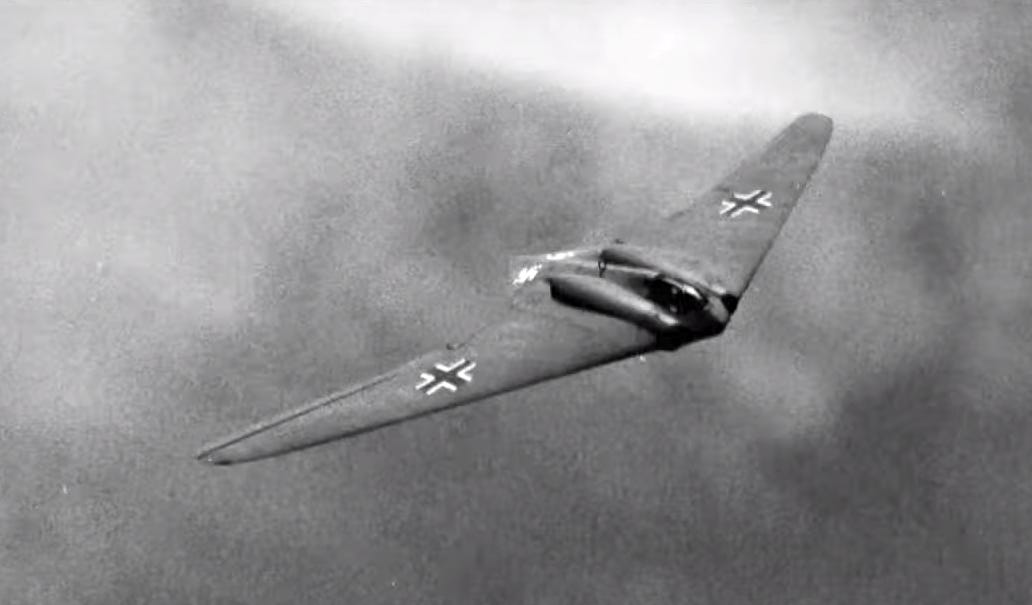
Germany c.1942 Flying Wing.
Because I already knew, somewhere I had not connected yet, that the certainty was a lie. I knew it from a curved stick.
Every kid who has ever thrown a boomerang has run the same experiment. You hold it and your eye tells you it is wrong — bent, lopsided, not the clean straight line a thrown thing is supposed to be. It looks like less than a proper projectile. And then you throw it, and the wrong shape does something a right shape never could. The proof is in the throw. The stick that looked like a mistake was carrying forty thousand years of knowledge your eye was too modern to read.
I filed the shape in the fog the way every kid files the boomerang before the throw — as an oddity. A curiosity that didn’t fit. I had no idea I had just seen the future of military aviation. I had no framework for it. I went home and grew up and became an engineer, and the shape waited.
It waited about as long as it had waited for everyone else.
The shape was scrapped, the first time around. Not shelved — scrapped. Cut up. In the late 1940s an American engineer named Jack Northrop built a series of flying wings, all wing and no tail, and watched the program cancelled and the prototypes physically destroyed at the end of the 1940s. They were aerodynamically efficient and they were, for their moment, uncontrollable — an all-wing aircraft with no tail is inherently unstable, and there was nothing in 1949 fast enough to correct it instant by instant the way the design demanded. The shape was right. The world was early. There was no machine yet that could do for the wing what a human arm does for the boomerang — hold it true through the part of the flight where it wants to tumble.
So the institution scrapped the wing and Northrop kept his patience, which turned out to be the only part of the program worth keeping.
Thirty years later, dying, unable to walk or speak, he was given a security clearance and taken into a secret room and shown a scale model of a new bomber his old company was bidding to build. It was his shape. The flying wing, come back from the scrap heap, about to become the most advanced aircraft in the world. He is reported to have said he finally understood why God had kept him alive the past twenty-five years. He had waited three decades to be told the shape was never wrong. The world had just been early.
I was not in that room. But I had been on that mountain, and when the B-2 Spirit was finally rolled into the daylight at the end of the 1980s — all wing, no tail, the shape from the fog made real and black and enormous — I did not have to wonder where it came from. I knew the lineage on sight. Everyone around me was scratching their heads at the alien thing on the runway. I was looking at the boomerang, grown up.
Here is how you build it, if you want to feel the logic in your own hands. You do not start from genius. You start from an ordinary bomber and an eraser.
Take a conventional aircraft — a long tube of a fuselage, a wing through the middle, a tail at the back with a rudder and elevators, ailerons out on the wings. Now start removing the parts that are only there to carry other parts. The long body between the crew and the rudder is mostly commute — empty distance the control has to travel to reach the surface that does the work. Trim it. The structure between the crew and the elevators, between the crew and the ailerons — commute. Trim it. You are not removing function. You are removing the hallway the function walks down.
Then you do the higher move. The surfaces that are left, you make each one do more than one job. Let the elevators and the ailerons become the same surfaces, handling both pitch and roll at once — engineers call the result elevons, and they are the signature of every flying wing. Let the rudder’s job — yaw, the side-to-side — be done by the wingtips dragging differentially, one side biting the air harder than the other, instead of by a vertical fin you have to carry. Keep trimming. Keep reassigning every job to a part that survives the cut. When you can’t trim any more, when every remaining surface is already doing several jobs and nothing is left that exists only to carry something else, look at what you have.
You have the wing. You have the boomerang. You did not design it. You uncovered it, by removing everything that wasn’t it.
That is TRIZ trimming — the discipline of deleting a component and handing its function to a component that remains — run all the way to the bone. And it explains the thirty-year wait in one clean stroke: every function on that aircraft could be trimmed in 1949 except one. The instant-by-instant correction that an unstable wing needs to keep from tumbling — that job could not be handed to any surviving part, because no surviving part was fast enough to do it. The boomerang hands that job to a human arm and forty thousand years of carved geometry. The B-2 had to wait for the flight computer, the fly-by-wire nervous system fast enough to be the wing’s reflexes. Northrop didn’t lack the shape. He lacked the one part of it that couldn’t be carved — and he died the year before the computer that finally could.
And now the part that turns an efficient shape into a weapon. When you trim the bomber down to the wing, you do it for weight and for drag. But look at what else leaves with every cut.
Every surface you trim is a surface that can’t reflect a radar pulse.
The tail you deleted is the radar return you no longer have. The fuselage you erased is the echo that never comes back. Stealth was not added to the flying wing. Stealth is what was left after everything else was taken away. The same cut that removed the weight removed the signature, in one stroke, and that is the rarest thing in engineering — one subtraction resolving two problems that have nothing to do with each other. Less drag and less detectability, off the same eraser. The flying wing isn’t efficient and stealthy as two separate achievements. It is both because it is trimmed. Less is not the compromise the designer settled for. Less is the entire design.
Less Is More, Said to Three Different Sensors
Once you see stealth as the refusal to emit, you start seeing it everywhere, because a machine can be found in more than one way and the same discipline answers all of them.
A radar finds you by the pulse you bounce back. Trim the surface, and there is no bounce — the flying wing’s answer.
A heat-seeker finds you by the fire you trail. The most detectable thing on a fighter is its afterburner, a raw column of flame, a screaming beacon in the infrared. The cure is supercruise — sustained supersonic flight with no afterburner, which the F-22 does and which the new commercial supersonic engines are being built to do. You go fast with no flame behind you. That is the same principle — emit nothing you don’t have to — applied to the heat channel instead of the radar channel. A different cut, the same idea.
An ear finds you by the bang. A sonic boom is an acoustic emission, a broadcast of your position and your speed that rolls across the ground for miles. The newest supersonic designs chase what they call boomless cruise — shaping the airframe so the shockwave never coalesces into a single sharp blow at ground level. And notice where that cut is made: not in the engine, but in the shape. The boom is made by the geometry and quieted by the geometry — which puts it on the same blade as radar stealth. Trim and contour the airframe, and the sound goes the way the radar return went.
Three sensors. Radar, heat, ear. One law answers all of them: give them nothing to detect. The flying wing took it to heart in the radar channel forty years ago. The supercruise engine takes it to heart in the heat channel. Boomless cruise takes it to heart in the acoustic channel. Less is more, repeated to three different sensors, and every one of those answers is a surface, a flame, or a sound that an engineer chose not to make.
Count the Second Generations
Here is the test that sorts every great machine, and it is just counting.
The M1 Abrams is the finest tank ever built, and it has no successor — only heavier versions of itself, more armor bolted to the same hull, the single axis it can grow along. No Mark II. The line ends in iteration.
The F-20 Tigershark was a superb fighter and it has no successor, because it never had a first generation — it died in a museum, the last squeeze of a 1950s airframe with nowhere left to go.
Even the F-16 — and this is the one that proves the test isn’t about quality, because the F-16 won, it sold by the thousands and flies on four decades later — even the F-16 has no true second generation. The thing that replaces it isn’t an F-16. It’s a different aircraft, a different lineage. The F-16 line gets extended. It does not get succeeded.
Four magnificent machines, and not one of them produced an heir.
Then there is the B-2. The shape Jack Northrop was scrapped for in 1949 is the only one in the entire hangar that had a child. The B-21 Raider — same shape, new machine, not a heavier B-2 but a genuine next one — first flew in November 2023, flew a second test aircraft in 2025, and as of this month has an operational test pilot in the cockpit running it toward combat, ahead of schedule, with delivery to its first operational base set for 2027 and a fleet of at least a hundred planned. A 180-day flight-test campaign was reportedly completed in 73 days. The child is not a concept. The child is in the air.
And the verdict beyond the verdict: the shape is no longer the American gamble. Every indication is that China’s next bomber and Russia’s next bomber will be flying wings too. America, China, and Russia, designing their most advanced strategic aircraft independently, all converged on the shape one man was ridiculed and scrapped for carving. When your rivals copy your design without being told to, the argument is over. That is the closest thing engineering has to a courtroom verdict.
So the test stands, and it is the spine of everything: the M1, the F-20, the F-16 died of more — more armor, more airframe, more capability bolted onto a finite platform. The B-2 survived by less, and less is the only one of them that had a child. You can build a second generation on a principle. You cannot build one on a platform.
The B2 and the Next Generation B21.
A platform is a finite answer and it gets used up. A principle breeds. Addition is terminal. Subtraction is generative. The boomerang proved the shape works for forty thousand years; the B-21 proves the shape propagates.
The Eraser Is Still in the Hand
The B-21 is not the end of the trimming. It is the proof the trimming works.
The eraser is still in the engineer’s hand, and every generation of this shape is the same cut taken one pass deeper — a function removed, reassigned to what remains, the system doing more while the system itself disappears. There is no natural place where that operation stops, as long as there is a job that can be handed to a part that survives the cut.
And the flying wing is young on its own curve. Every technology climbs an S-curve — slow at the start, steep through its prime, flat at the end where more effort buys less and less. The flying wing only began its climb when the computer arrived to be its reflexes, which means it has decades of steep climb left as new inputs feed the same shape: better materials, better sensors, autonomy that trims away even the crew. The shape is not finished improving. It has barely started.
But the S-curve is also a warning written in the same ink, and an honest engineer reads both halves. Every principle climbs and then it flattens. The M1 flattened — heavier and heavier for less and less, the top of its curve, nowhere left to climb. The F-20 launched already at the top of the curve it was born on. The flying wing is climbing now, and someday it too will plateau, and when it does, the next leap will not come from a better wing. It will come from a shape nobody has drawn yet — sketched by someone the institution hasn’t met, someone who will look at our most advanced bomber the way I once looked at an odd shape in the fog, and see the throw before the next one.
That is the only forecast worth making, because it is the only one that is always true. Not which machine comes next — the shape of how it will come. Another principle. Another curve. Another object that looks wrong to every trained eye right up until someone makes the throw, and the wrong shape does what the right shape never could.
We tell ourselves the lesson of the flying wing is that the experts were wrong in 1949. They were — but that is not the lesson. The lesson is older than the airplane and we have known it since we were children with a curved stick in our hands. The shape that looks like less is the shape that does the impossible. The eye is always slow. The throw always settles it.
Every surface you trim is a surface that can’t reflect a radar pulse. Northrop knew it and died waiting for the world to catch up. The boomerang knew it before there was a word for radar, or for flight, or for an engineer. And somewhere right now a kid is on a foggy road, looking for the monument everyone told him to find, about to notice the wrong-looking thing beside it — the one that will not let go of him, the one he won’t be able to name for thirty years.
Throw it. The proof was always in the throw.
Herbert Roberts, P.E. is a licensed professional engineer with 32 years in aviation research and development across two companies, and has spent eight years analyzing accidents for attorneys under his P.E. license.
Herbert Roberts, P.E. is a licensed professional engineer with 32 years in aviation research and development.