


The Contract That Was Supposed to Make Failure Impossible
They called it risk transfer. A fixed price, locked in before a single rivet was cut, so the taxpayer would never eat a cost overrun again.
That’s not risk transfer. That’s a translation failure with a $1.35 billion price tag.
What actually happened was simpler, and more damning:
The Navy needed a stealth attack aircraft to replace the A-6 Intruder on carrier decks.
In 1988 it signed McDonnell Douglas and General Dynamics to a fixed-price contract for the A-12 Avenger II — a flying-wing design built around a heavily composite structure.
The composite wing, carrying much of the aircraft’s stealth shaping, came in significantly overweight.
The overweight wing meant the aircraft could not meet its carrier landing weight limits — not a marginal miss, a structural one.
The problem required a redesign, not a manufacturing fix.
The contractors kept building anyway, and the full scope of the weight problem was not disclosed to Navy oversight as it was discovered.
By January 1991, the losses were unrecoverable and the technical picture was unrecognizable from what the contract assumed. Secretary of Defense Dick Cheney cancelled the program outright.
Total contractor losses: roughly $1.35 billion. Litigation over the termination ran for over two decades — well into the 2010s — before it was finally resolved.
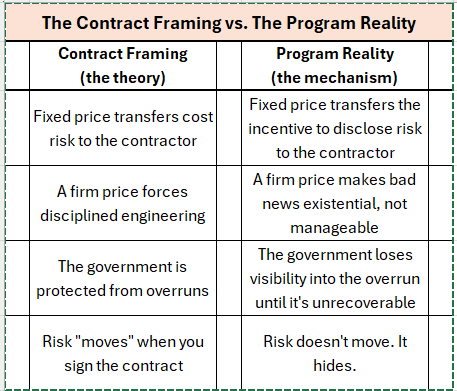
The theory of fixed-price development is clean: put the financial exposure on the party building the thing, and you’ll get honest, disciplined engineering, because they can’t afford not to. It’s a good theory for a known product built with known processes. It is a bad theory for developmental engineering with real unknowns still on the table — because in that situation, the contractor isn’t just incentivized to solve the problem cheaply. They’re incentivized to not tell you the problem exists, for as long as the math lets them believe they can still solve it before anyone has to write the check.
That is not a hypothetical failure mode. That is exactly what the A-12 record shows.
The Architecture Problem
Composite structures were still a maturing discipline in naval aviation in the late 1980s. A flying-wing design pushed a huge fraction of structural and stealth-shaping load into that composite wing — high-payoff engineering, and high-uncertainty engineering, in the same part.
High uncertainty and a fixed price are not compatible inputs. One of them has to give. On the A-12, the uncertainty didn’t shrink. The disclosure did.
This is the same pattern that shows up anywhere a contract, an incentive plan, or a performance metric is built on the assumption that the problem is already well understood at signing. When the assumption is wrong, the instrument doesn’t produce honesty under pressure. It produces concealment under pressure — right up until concealment is no longer possible, at which point the failure arrives all at once, at maximum cost, instead of early and cheap.
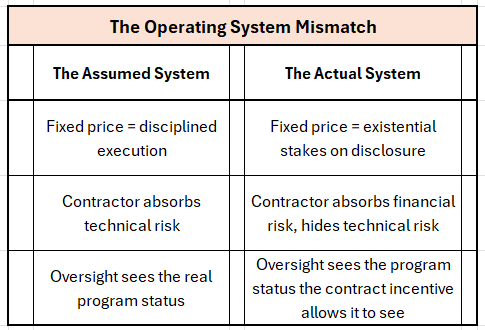
The Navy didn’t lose oversight because anyone was incompetent. It lost oversight because the instrument it built — the fixed-price contract — was structurally blind to its own failure mode. You cannot ask an organization to bet its survival on hitting a number and also expect it to volunteer, early and often, that it’s about to miss.
The Cascading Cost
The explosion did not stay in the wing.
McDonnell Douglas and General Dynamics absorbed the direct losses. The Navy lost its next-generation carrier-based stealth strike capability with nothing queued to replace it — a capability gap that shaped carrier air wing planning for years afterward. And the termination itself became a two-decade legal fight over who owed whom, consuming legal and program-office attention long after the aircraft itself was forgotten.
A composite wing that came in overweight didn’t just kill one program. It rewrote how the Pentagon thought about fixed-price development contracts for advanced aircraft for a generation.
Clarity as the Missing Control Loop
Complex programs don’t fail because contractors are dishonest by nature. They fail when the incentive structure and the technical reality are pointed in different directions, and nobody has built a control loop fast enough to catch the divergence before it becomes unrecoverable.
A fixed-price contract is not a control loop. It’s a bet. It only works when the thing being bet on is already well characterized. The moment real engineering uncertainty is still on the table, the fixed price stops enforcing discipline and starts enforcing silence.
The Most Expensive Metaphor
A $1.35 billion contract termination is simply the most visible version of a pattern running in most organizations right now: an incentive structure built on the assumption that the hard part is already solved, applied to a problem where it isn’t.
The engineer who knows the wing is overweight and says nothing because the program can’t survive saying so out loud is not a rare person. They are the predictable output of an instrument that rewards confident numbers over honest ones.
If your organization’s contracts, comp plans, or KPIs assume the risk is already known, you already know which version of this story you’re building toward.
The physics — and the balance sheet — will eventually enforce the truth either way.
Herbert Roberts, P.E. is a licensed professional engineer with 30+ years in aviation research and development across two companies, and has spent eight years analyzing accidents for attorneys under his P.E. license