


The Leaning Tower of Pisa: Eight Centuries of Engineers Optimizing a Foundation Nobody Questioned
360 Engineering Series
The ticket seller did not explain it in a language I could understand.
In my early teens, you could still buy a ticket and climb the Leaning Tower of Pisa. I understood I was going to climb a famous leaning tower. What I had not been told — or had not understood, which amounts to the same thing — was what climbing it actually meant.
The path is not an interior staircase. It is the outer ring of the tower — a continuous spiral gallery along the outside face, roughly two and a half feet wide, single file, with ancient polished marble under your feet and, between the narrow columns holding up the next level, nothing. No railing. No barrier. Just the narrow walk path and a series of bad options all the way to the top. The columns are beautiful and exactly the wrong distance apart to provide any security for someone who has just realized what is missing between them.
There were perhaps twenty of us on that climb. Not all teenagers. On a single-file path the slowest person sets the pace, which means everyone stops when anyone stops. When you stop on the downward-leaning side of a tilted spiral, the polished marble beneath your feet is not level. It is a slope. The slope points toward the unguarded edge. The unguarded edge points toward the ground, a long way below. The marble is smooth enough that standing still requires a continuous decision about where your weight is going. There was a lot of grabbing on the wall side of the spiral, there was just no hand-holds to support yourself on the wall just smooth marble and a lot of dirt from sweat streaks and tears left on the wall from the past tourist ie. terror victims.
The higher we climbed, the more you looked down to the earth — unsupported, on the down-leaning side — through columns that were never designed to be reassuring.
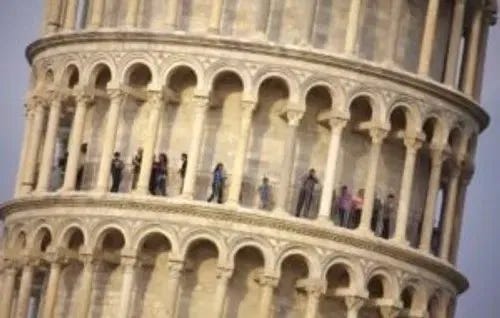
Photo Caption: A mid-section of the Tower of Pisa with tourist walking on the outer spiral.
We stopped just below the widest gallery ring at the top, as far as visitors were permitted. Twenty people on a two-and-a-half-foot ledge, the slowest among us resting on the most advanced leaning section, the polished marble offering every standing foot a quiet and insistent argument for movement in the wrong direction. Then the guide called for the return.
Everyone do a 180. Follow the person who was behind you, back down the same path.
What becomes obvious only after you have already turned is that the leaning edges are now on the side that was at your shoulder going up. The column that offered a half-inch of psychological comfort on the ascent is now the open side. The drop that had been at your elbow is now where the wall had been. Same path. Same marble. Same gravitational opinion about where you belong.
I came down that tower with a physical understanding of what a lean actually does to your relationship with a flat surface. It is not a visual novelty. It is an ongoing negotiation between your center of gravity and the geometry under your feet.
Years later, reading about the engineers who returned to that tower for eight centuries and adjusted the upper floors to compensate for the lean without once questioning the foundation beneath it, I understood them completely. Not because they were right. Because I had stood on what they were compensating for — high above the city, nothing between me and the evidence — and never once asked what was causing it either.
The Decision That Defined Eight Hundred Years
Construction on the Tower of Pisa began in 1173.
The tower started leaning before the third floor was complete.
The builders stopped — not because they understood the structural problem, but because Pisa went to war with Genoa and the money ran out. The pause lasted nearly a century. When construction resumed in 1272, the engineers did something that would define every subsequent intervention for the next eight hundred years.
They compensated.
They built the upper floors with one side slightly taller than the other to make the tower appear straighter. They adjusted the geometry to manage the visible symptom rather than interrogate the cause. They optimized the presentation of the structure without identifying the governing failure mode.
The tower continued to sink.
That single decision in 1272 — compensate rather than investigate — established the template. For eight centuries, engineers returned to the Tower of Pisa and asked the same question: how do we manage the lean? Nobody asked the first-principles question until 1990: why is it leaning?
The distance between those two questions is the entire article.
What the Ground Was Actually Doing
The tower sits on the southern bank of the Arno River, on soil deposited over thousands of years by water, flood, and sediment. That matters because river sediment is not a uniform material. It is a layered record of changing conditions — coarse deposits, fine silts, soft clays, variable moisture content, and abrupt shifts in stiffness with depth. In one location, the ground may behave like a competent bearing surface. A few meters away, it may behave like a compressible sponge.
The original foundation design assumed the soil under the tower would behave uniformly across its footprint. That assumption was not unreasonable by medieval standards. It was simply unverified.
The south side of the foundation rested on softer, more compressible material than the north side. As the tower rose and its weight increased, the south side settled faster. That differential settlement caused the tower to rotate slightly. The rotation changed the load path — more weight shifted toward the already-settling side. The altered load path intensified the asymmetry. The asymmetry increased the rotation. The cycle fed itself.
At its worst, before the 1990 intervention, the top of the tower was displaced nearly five meters — more than fifteen feet — from where it would have stood if the foundation had been uniform. That is not a lean. That is a controlled structural argument with gravity that the tower was slowly losing.
This is also where the time scale of the problem becomes important.
Soil behaves differently over short and long timescales in a way that steel and concrete do not. A soft clay layer may carry a load initially, then slowly compress over years and decades as pore water drains and the soil consolidates under sustained stress. The ground may look stable at first and keep moving for a generation. That process — called consolidation in geotechnical engineering — is one reason soil problems are so treacherous. The response to loading is not just a question of immediate strength. It is a question of drainage, permeability, stress transfer, and duration.
The tower was not merely leaning in the present tense. It was continuing to lean in the future tense, driven by a mechanism that was invisible to everyone looking at the marble columns above.
Why Visibility Dominated the Thinking
Once the tower began to lean, the lean became the problem everyone could see.
That is how systems trap decision-makers. Visibility creates false priority. The most observable variable becomes the one people optimize, even when it is not the one driving the failure.
The builders and later engineers were not irrational. They were responding to what was in front of them. The tower was visibly tilting, and that tilt threatened both the structure and the prestige of the city. The instinct — preserve appearance, preserve function, preserve the monument — was reasonable under the circumstances. Build the next floor straighter. Add countermeasures. Keep the structure alive.
But every one of those interventions happened above the real failure plane.
The superstructure was being treated as though it were the cause. It was not. It was the victim.
This is a pattern I have seen in engineering programs and in organizations: when a system behaves badly, people look at the most obvious layer — the output, the failure report, the visible symptom, the dashboard reading. They respond to the most measurable consequence because it is actionable. What they do not ask is whether the visible consequence is merely a translation of a deeper condition that has not yet been named.
The Tower of Pisa is what happens when that question is postponed for eight hundred years.
Every compensation the medieval builders made was structurally coherent at the layer they were working on. The geometry of the upper floors was adjusted with genuine skill. What they were doing, precisely, was making the wrong layer look right. The load still traveled downward into uneven soil. The correction affected appearance more than cause.
That distinction is subtle and central.
Many systems survive for long periods because their compensations are good enough to prevent collapse. But good enough creates a specific illusion: once a compensation is in place, the original defect becomes harder to notice because the system no longer looks like it is in crisis. It looks managed. Managed systems stop receiving the hard questions. The hard questions go to the systems that are visibly failing.
Pisa was managed for centuries. That is not the same as understood.
The 1990 Shift: Changing the Question
The intervention in 1990 marked a different kind of engineering mindset — not more modern in its tools, but different in its question.
By then, the lean had reached the point where the structure was closed to visitors. The concern was no longer aesthetic. It was structural. The tilt was continuing to increase, and the risk of catastrophic failure was real enough that the Italian government assembled an international commission to address it.
Earlier generations had effectively asked: how do we keep this tower from leaning too much?
The 1990 commission asked: what physical mechanism is producing the lean?
That question changed everything.
The commission investigated the subsurface conditions using geotechnical methods that allowed them to map the soil profile, identify the compressible layers, and understand the asymmetry in the foundation response. They confirmed that the tower’s tilt was being driven by differential settlement in a weak clay layer on the south side — not by any flaw in the masonry, not by an uncontrollable geometric accident, but by a specific, identifiable, and addressable condition in the ground that had been doing its work, unquestioned, for eight centuries.
Once they understood that, the solution space changed completely.
They did not rebuild the monument from scratch. They did not add massive visible supports that would have altered the structure’s appearance. They did not counterweight the high side and hope for the best. Instead, they removed soil carefully from beneath the north side, allowing that side to settle slightly — reducing the differential, rebalancing the foundation geometry, and bringing the tower back toward equilibrium.
The result was a reduction in lean of approximately forty-four centimeters. The tower reopened in 2001. It has remained stable since.
That is a remarkably elegant solution because it works with the governing physics rather than against the visible symptom. The tower was stabilized not by forcing it upright but by modifying the boundary conditions underneath it.
The Engineer Move: Boundary Conditions Are Where the Physics Lives
There is a principle worth naming explicitly, because it applies far beyond marble towers and river sediment.
If the problem is in the boundary condition, the answer is in the boundary condition.
Not in the compensation above it. Not in the decoration around it. Not in the cosmetic correction that makes the output easier to tolerate. The boundary condition is where the physics lives, and any intervention that does not reach the boundary condition is managing the symptom while the cause continues its work.
The 1990 team understood this. Every medieval engineer who added a slightly taller course on the short side did not — not because they lacked intelligence, but because the governing question had never been formally asked. The boundary condition had never been mapped. The assumption that the soil was uniform had been placed under the program at the beginning and left there, untouched, while eight hundred years of skilled engineering effort was applied to the structure above it.
That is the forensic signature of this failure mode: an assumption installed at the base of a system, never stripped, while every subsequent generation optimizes the layer they can see.
The tower did not fail because medieval engineers were incompetent. It persisted as a problem because the question that would have exposed the foundation assumption was never formally asked. When it finally was asked — directly, in 1990, by people who were willing to follow the answer wherever it went — the system responded.
The Failure Mode That Goes Everywhere
The Tower of Pisa is a monument. It is also a diagnostic tool.
Every engineer who has worked inside a long-running program has encountered the boundary condition that nobody questions. It was there when you arrived. It has the authority of assumption, which is the most durable kind of authority because it is invisible. The visible layer gets reviewed. The visible layer gets optimized, adjusted, and corrected. The assumption underneath it does not come up in design reviews because it was never written down as a decision. It was simply the floor the program was built on.
The question that the Tower of Pisa puts to every engineer and every organization is not whether you have compensating systems. You do. Every complex system does. The question is whether any of your compensating systems are doing for your organization what the offset upper floors did for the tower — making the visible output look acceptable while the governing condition underneath continues, unaddressed, to shape everything above it.
The lean is never the problem.
The lean is what the problem looks like from where you are standing.
The only way to find out what is actually driving it is to go looking in the layer you have been standing on.
Herbert Roberts, P.E. is a licensed professional engineer with 32 years in aviation research and development across two companies, and has spent eight years analyzing accidents for attorneys under his P.E. license.
Dennis — that's a great find. The soil extraction work is exactly where the real engineering drama lives. Thanks for sharing it with the community, and thanks for being here.
Here's a great watch about the soil removal intervention:
https://www.youtube.com/watch?v=au8Dm-rZOWc