


The Paperwork Was Perfect. The Truss Was Not.
They called it quality assurance.
A bundle of documents, certifying that an imported steel truss had been welded to the design drawings and fabrication requirements.
That’s not quality assurance. That’s a signature on a promise nobody checked.
What actually happened was simpler, and more damning:
A 440-tonne structural steel package for the Kew Recreational Centre redevelopment in Melbourne was fabricated by a subcontractor in China and shipped to Australia.
The façade contractor and principal contractor visually inspected the first few shipping containers of steel.
The imported truss — designated GT1, a large structural component spanning the pool hall — arrived with a bundle of quality assurance documents attesting it had been welded in accordance with the design drawings and fabrication requirements.
Nobody with the competence to verify those documents actually checked them against the physical steel.
The truss was erected in February 2022. It was not fabricated to the design drawings and fabrication requirements it was certified against.
The structure sat erected — and structurally unsound — for eight months, with workers present on and around the site the entire time.
In October 2022, during a paint work inspection, defective welding was discovered. Remedial work began.
The truss collapsed that same night, when no one was on site.
Nobody died. The regulator’s own language makes clear how close that came to being luck rather than outcome: “It was pure luck that the risk didn’t eventuate when people were on site.”
The Certification Language vs. The Physical Reality
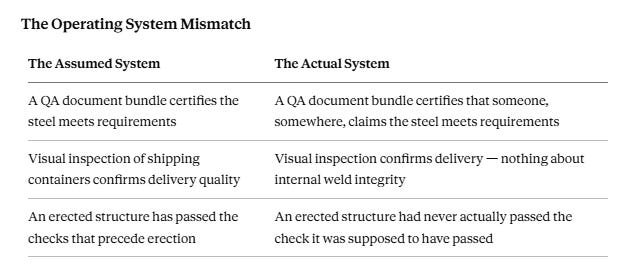
The paperwork wasn’t forged. It was simply never verified against the thing it described. That gap — between a document that says the work was done correctly and steel that says otherwise — sat unexamined for eight months, through every day workers moved through and around that pool hall.
The Architecture Problem
Importing structural steel at scale is a supply-chain problem wearing an engineering costume. The physical fabrication happens somewhere the buyer cannot watch it happen. What arrives instead is a package: the steel, and a set of documents asserting the steel meets specification.
Those two things — the object and the paperwork about the object — are not the same thing, and a system that treats them as interchangeable has already built its own failure mode into the process. A visual inspection of a shipping container tells you the crate arrived. It tells you nothing about whether the weld inside the truss meets the design’s structural requirements. That verification requires someone competent to actually check the QA documentation against the fabrication — not glance at it, not file it, check it.
That check never happened here. Not because anyone decided to skip it. Because nothing in the process assigned the check to anyone in particular.
The Operating System Mismatch
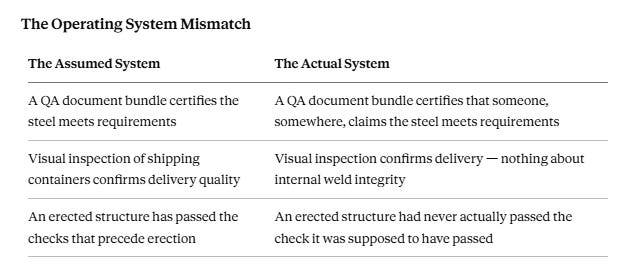
The regulator’s own summary of the fix required is the clearest possible statement of the mismatch: “Having a robust system in place to ensure steelwork meets specific design requirements and Australian standards is simply a non-negotiable when importing products from overseas.” Non-negotiable, and also — on this project — absent.
The Cascading Cost
The truss’s collapse didn’t stay contained to one component.
The façade contractor that fabricated and erected the steel was fined $400,000 and has since gone into liquidation. The principal contractor entered an $850,000 enforceable undertaking — not just a fine, but a mandate to research and draft a new industry standard for structural steel procurement, fabrication, and erection, with a specific focus on welding quality assurance. The project itself stalled for two years before resuming. A regulatory body filed eighteen separate charges against the fabricator and its director, prosecution ongoing years later. And the reputational cost followed the parent company to its next project — a separate council was forced to publicly promise, before construction even began, that steel on its new build would be sourced domestically.
One unverified weld, certified on paper as compliant, produced a cost that outlived the truss itself by years.
Clarity as the Missing Control Loop
Complex supply chains don’t fail because nobody cares about quality. They fail when the artifact that’s supposed to prove quality — the certificate, the inspection report, the QA bundle — gets treated as equivalent to the verification it’s supposed to represent, instead of as a claim that still needs checking.
A shipping container passing customs is not the same event as a weld meeting a design drawing. An organization that can’t tell those two events apart in its own process will eventually erect something on the strength of a document nobody actually verified — and then discover, on a lucky night with no one on site, exactly how much weight that document was never carrying.
The Most Expensive Metaphor
A collapsed truss is simply the most visible version of a pattern running in any organization that outsources a critical function and accepts the paperwork as proof the function was performed.
The engineer who signs off on a vendor’s certification without independently verifying it isn’t lazy. They’re the predictable output of a process that never assigned anyone the job of checking the check.
If your organization treats a certificate as equivalent to the verification it claims to represent, you already know which version of this story you’re building toward.
The steel doesn’t care what the paperwork says. It only cares what it was actually welded to hold.
Herbert Roberts, P.E. is a licensed professional engineer with 30+ years in aviation research and development across two companies, and has spent eight years analyzing accidents for attorneys under his P.E. license