


The Plane on the Bookshelf
I did not believe in instructions, because I had none.
My parents were practical people, and most of the toys I had were hand-me-downs. Other than a brown bag of green army men, my primary toy set growing up was a large box of orphaned Lego blocks. When new, Legos came in kits with an illustrated set of instructions. My large box of orphaned blocks had no instructions and therefore had no limits beyond my imagination. And as older kids grew out of Legos, my parents would offer to take their blocks and so by 4th grade, I had a substantial collection — multicolored, mixed, unsorted, and entirely mine. I was the chief builder at HerbCo Industries, which existed entirely on the floor of my bedroom.
This was the early 1970s. Lego had not yet discovered that children would pay extra for licensed castles or branded spaceships. Most sets at the time were houses — which came with clear blocks for windows and small flat pieces hinged to swing as doors. Boring. But the bricks themselves were not boring. The bricks could span a gap as a bridge or stack into a tower that reached to the ceiling. I built things, decided they were finished, and tore them down to build the next thing.
Then it happened. My grandmother gave me a brand new set of Lego blocks in the form of a tractor set. I had never been given a “new" box of Legos before and this kit came with wheels, also something I had never had before. Suddenly my Lego empire had gone mobile.
The tractor had large rubber-coated wheels for the rear, small rubber-coated wheels for the front. I had never had wheels in my Lego box before and now I had two sizes. I built the tractor once, kept the wheels, and threw the rest into the big box.
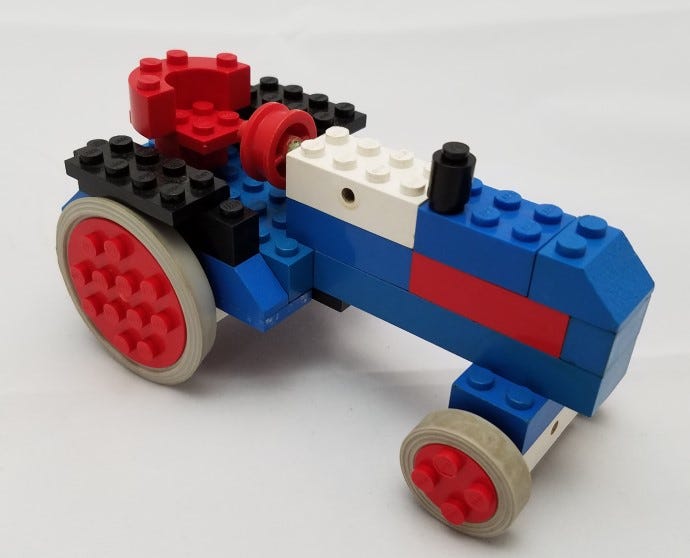
Lego tractor set, ©1963. The wheels that started everything.
The wheels changed everything.
The wheels were disruptive technology. One new element entered a familiar system, and the system reorganized itself around the new element. Building bridges and towers was over.
My civil engineering phase ended the day I built a top fuel dragster. The big rear wheels went on the back. The small wheels hung out the front of a long, lean torpedo. Three red blocks side-by-side made an engine powerful enough that the dragster pulled wheelies everywhere it went.
My automotive engineering phase ended when the dragster came apart. The small wheels became the landing gear for an airplane I designed on my own — no instructions to throw away, because no instructions had ever existed. The plane was simple. Clean white blocks, a spinning propeller in the nose made from a flat plate Lego attached to what had once been the tractor's steering wheel, and matching flat plates for the rear elevators and rudder.
HerbCo Aviation, Airplane #1.
The plane I kept. While other builds came and went, the plane stayed assembled on my bookshelf, ready to take off and fly around the room at a moment's notice.
Sometime later that year, the toy store put up a display: Lego was running a contest. Children were invited to mail in photographs of their original designs for a chance to win prizes. I do not remember what the top prizes were. I photographed my airplane and mailed the pictures off. (Unfortunately, I have no idea what happened to the photos of the plane I did not send in)
Four or five months later a letter came back. My airplane had won 4th place. A prize was on its way. Congratulations.
Fourth place felt enormous. I, a young school boy, had won something for an idea that had been mine, built from a tractor's wheels and a box of orphaned blocks.
A month later the prize arrived. The box was 18 inches by 18 inches by 12 inches and addressed to me. Inside were about sixty Lego kits — all of them identical, all of them basic blocks, none of them with wheels or any other special piece.
The prize sets from Lego were nice, but the real prize had arrived months earlier, the day my grandmother handed me a tractor kit.
My parents stepped in, and they were right. I already had more blocks than any one child needed, and these new kits added nothing my collection did not already contain. I was allowed to keep five. The rest went on a back shelf in the closet. For the next five years, every time a friend's child had a birthday, a box came down from that shelf, was gift wrapped, and went to the party.
Years later, engineers I told this story to pointed out the obvious. There were probably hundreds of 4th place winners, and the sixty identical kits were almost certainly slow-moving inventory Lego needed to move. The contest was marketing. The prize was warehouse cleanup.
They were almost certainly right. And it does not matter. The tractor my grandmother put in my hands was not part of anyone's inventory plan. It was the gift that rerouted a 9-year-old's career three times in a single afternoon — civil to automotive to aviation — and Lego had nothing to do with that part.
Time passed. Lego became a memory. I took apart our lawnmower engine, then a car's engine, then larger and more complicated things. The bookshelf plane disappeared somewhere in the moves of growing up.
Ten years ago my mother passed away, and our family gathered to clean out the house. In a back closet of one of the bedrooms I found a white box that had been crushed under heavier boxes stacked on top of it. Inside, three of the last Lego prize kits sat still wrapped in their original plastic.
A flood of memories came back. I was in 4th grade again, and I had my little plane in hand, buzzing around the house.
I was flying again.
Herbert Roberts, PE • Inventor’s Mind • inventorsmindblog.com
The Inventor’s Mind Substack publishes twice weekly — built for engineers who are still paying attention. Free, at inventorsmindblog.com.
Source credit — Image: Lego tractor set, ©1963 LEGO Group