


The System That Worked Exactly as Designed
The NTSB said it plainly: the ice-protection system functioned as designed.
That sentence is true. It is also the most misleading true sentence in the entire report.
What actually happened was simpler, and more damning:
On February 6, 2025, Bering Air Flight 445, a Cessna 208B Caravan on a scheduled Part 135 commuter run to Nome, Alaska, encountered icing more severe than forecast.
The aircraft’s TKS ice-protection system engaged and worked exactly as it was built to work — it prevented dangerous ice buildup on the protected surfaces.
Managing that system, on top of an already-degraded weather picture, added workload.
The added workload eroded situational awareness of airspeed.
The aircraft was also operating more than 1,000 pounds over its maximum gross weight for known icing conditions — one of many flights in a documented pattern of routine overweight operations at the airline.
The overweight condition left less margin to recover once the stall began.
Airspeed decayed to 89 knots. The pilot’s nose-up input deepened the stall instead of breaking it.
All ten people aboard were killed.
NTSB Chair Jennifer Homendy’s own words: the crash was not one failure. It was a series of preventable breakdowns that eroded critical safety margins, one on top of another, until there was no margin left.
The System Language vs. The Operational Reality
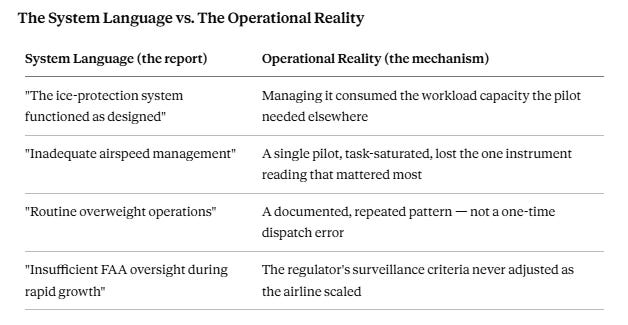
Every phrase in the left column is accurate. Every one of them is also doing the same job: describing a component in isolation, when the actual failure lived in the interaction between components that were each, individually, working roughly as intended.
The Architecture Problem
A functioning ice-protection system is not the same thing as a safe flight. It is one input into a workload budget the pilot is managing in real time, alongside airspeed, altitude, a closed and de-icing runway, a rebuilt approach, and — unknown to him in the moment — thin margin from an aircraft already over its safe operating weight.
None of those inputs was hidden from the system. All of them were hidden from each other. The ice-protection system didn’t know about the weight. The weight didn’t know about the workload. The dispatcher’s risk assessment didn’t catch the pattern of overweight flights because nothing in the operational control process was built to catch it. Each piece performed its function. Nothing was watching the sum.
This is the same architecture problem that shows up in any organization running near its design margins under schedule or operational pressure: individually defensible decisions, none of them cross-checked against the others, compounding into a single unrecoverable moment.
The Operating System Mismatch
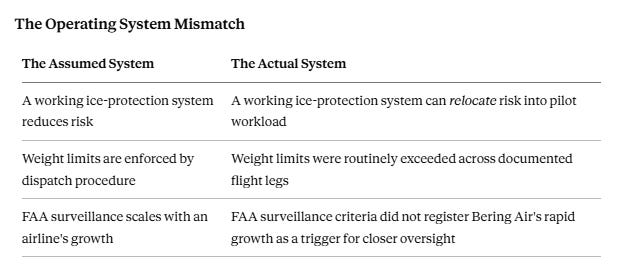
A single-pilot Part 135 operation assumes the operator’s dispatch and risk-management procedures are doing real work — catching the overweight flight before it leaves the ground, flagging the operational complexity that comes with rapid growth before a regulator has to notice it independently. On Flight 445, that assumption held on paper and failed in practice, seven times out of thirty-five reviewed flight legs.
The Cascading Cost
Ten people did not survive a flight where every individual safety system did roughly what it was built to do.
The NTSB’s response wasn’t a fix to the ice-protection system — it worked. It was a set of recommendations aimed at the seams between systems: mandatory upset-prevention training for single-pilot Part 135 operators, explicit surveillance triggers tied to an operator’s growth rate, and broader load-manifest requirements across the industry. The cost of this failure didn’t stay with one airline or one aircraft. It rewrote the oversight framework for how fast-growing regional carriers get watched.
Clarity as the Missing Control Loop
Complex operations don’t fail because every component is broken. They fail when each component is individually sound and nothing in the system is responsible for watching how they compound.
A regulator measuring individual compliance checkpoints will miss an airline that is compliant at each checkpoint and dangerous in aggregate. A pilot managing individually correct instrument readings can still lose the picture that matters most when workload rises faster than attention can track it. The control loop that was missing here wasn’t a piece of hardware. It was the function that should have been asking: what happens when all of these individually acceptable conditions occur at once?
The Most Expensive Metaphor
Ten lives is the cost of an industry-wide pattern most organizations run every day at a smaller, quieter scale: individually defensible decisions, made by people who are each doing their job correctly, that were never checked against each other before they compounded.
If your organization can point to every component and say “that worked as designed” after something goes wrong, you already know which version of this story you’re building toward.
The margins don’t announce themselves as they erode. They just get thinner, quietly, until there aren’t any left.
Herbert Roberts, P.E. is a licensed professional engineer with 30+ years in aviation research and development across two companies, and has spent eight years analyzing accidents for attorneys under his P.E. license
This piece draws on the National Transportation Safety Board’s final report on the February 6, 2025 accident involving Bering Air Flight 445 (NTSB report AIR-26-05) and public statements from NTSB Chair Jennifer Homendy. The finding examined here is systemic — the interaction of maintenance, dispatch, training, and regulatory oversight — not the judgment of the pilot in the final moments of the flight, who like the nine passengers aboard, did not survive.