


The X-Wing: The Stopped-Rotor Aircraft That Ran Out of Fuel
The Cancelled Files
I knew the X-Wing was dead before anyone told me officially.
I knew it the way you know anything inside a large aviation enterprise — not through announcement, not through memo, but through the sudden reappearance of people you had not seen in months. They came back into the daylight. They showed up in the hallways, in the cafeteria, at the coffee station with the look of people who had been staring at a problem that no longer existed. Within a week or two, intramural softball rosters that had been running short were full again.
That is what a cancelled program looks like from the adjacent corridor.
I was deep in other work at the time, heavy on programs that had nothing to do with stopped rotors or circulation control. No need to know, and so I had known nothing. The name X-Wing had circulated through the industry the way names of troubled programs always did — as shorthand for something technically ambitious that kept running on bad fuel. Word would come that it was going well, then word would come that it was nearly gone, then it would surface again with new funding or a revised schedule, then the cycle would repeat. I had heard that pattern often enough across a career in aviation R&D to recognize it as a specific kind of warning sign. Not every program with that pattern died. But almost every program that died had that pattern.
One morning in early 1988 it was over. The people came back. The name lingered.
It lingered long enough that years later I finally had to go look up exactly what had been going on. What I found was one of the most technically interesting cancelled programs in the history of American rotorcraft — and one of the clearest examples I have seen of the assumption that kills programs not by attacking the engineering but by never being questioned in the first place.
The Problem Every Rotorcraft Engineer Lives With
The helicopter is one of the most useful machines in aviation history and one of the most constrained by the physics of how it works.
It can take off and land vertically. It can hover indefinitely. It can operate from ship decks, mountain clearings, rooftops, and unprepared surfaces. It can maneuver at very low speeds in tight spaces, close to terrain and structures. For search and rescue, special operations, medical evacuation, shipborne logistics, and any mission that requires getting in and out of places with no runway, the rotor disc is irreplaceable.
Then you ask it to go fast, and the physics start arguing with you.
The problem is called the advancing-retreating blade asymmetry. At low forward speed, every blade sees roughly similar relative velocity as it sweeps through the disc. As the aircraft accelerates, the blade sweeping forward into the oncoming air sees increasing relative wind — more lift, more drag, compressibility effects that multiply with speed. The blade sweeping backward sees decreasing relative wind — less lift, and eventually the threat of stall. The rotor disc becomes an aerodynamic wrestling match. The faster you go, the harder the match. Above roughly 200 knots, conventional helicopters run out of options. The physics say stop.
I once heard a lunch-table proposal for solving this problem that has never fully left me.
The logic went like this: if the retreating blade is going to stall at high speed anyway, stop fighting it. Let it stall. The loss of lift on that side will roll the fuselage. Let it roll — all the way over, 180 degrees — at which point the blade that was retreating is now advancing, it regains lift, the other side stalls, and the whole cycle repeats. The aircraft would fly in a continuous spiraling corkscrew, trading stall and recovery on alternating sides of the disc.
Someone at the table called it the drunken eagle.
The group agreed it was technically honest — the physics did not prohibit it — and operationally insane. Nobody filed a patent. But the fact that it was generated at all, by serious engineers working on a serious problem over a lunch break, tells you something about the nature of the contradiction. When the solutions being explored at the edges of the problem space include controlled repeated stalls and barrel-rolling fuselages, the center of the problem space is genuinely hard.
Fixed-wing aircraft live at the other end of this trade. They cruise fast, fly far on the same fuel, carry more payload for the same installed power, and do it all without the constant gyroscopic, aeroelastic, and aerodynamic complexity of a spinning rotor disc. What makes a helicopter irreplaceable below 150 knots makes a fixed-wing aircraft irreplaceable above 300. The gap between those two envelopes is where every hybrid aircraft concept has to live, and where most of them have died trying.
Tiltrotors, compound helicopters, tail-sitters, lift-jets, and more exotic vertical takeoff and landing concepts all share the same fundamental problem: ask one aircraft to be both a true helicopter and a true fast airplane and you tend to pay twice — once in weight and complexity, and again in the performance penalties you accept in both halves of the mission.
The X-Wing’s Different Angle of Attack
The Sikorsky X-Wing, developed through a collaboration among NASA, the Defense Advanced Research Projects Agency (DARPA), and Sikorsky under a contract that began in 1982, attacked this problem from a direction that no previous concept had attempted at scale.
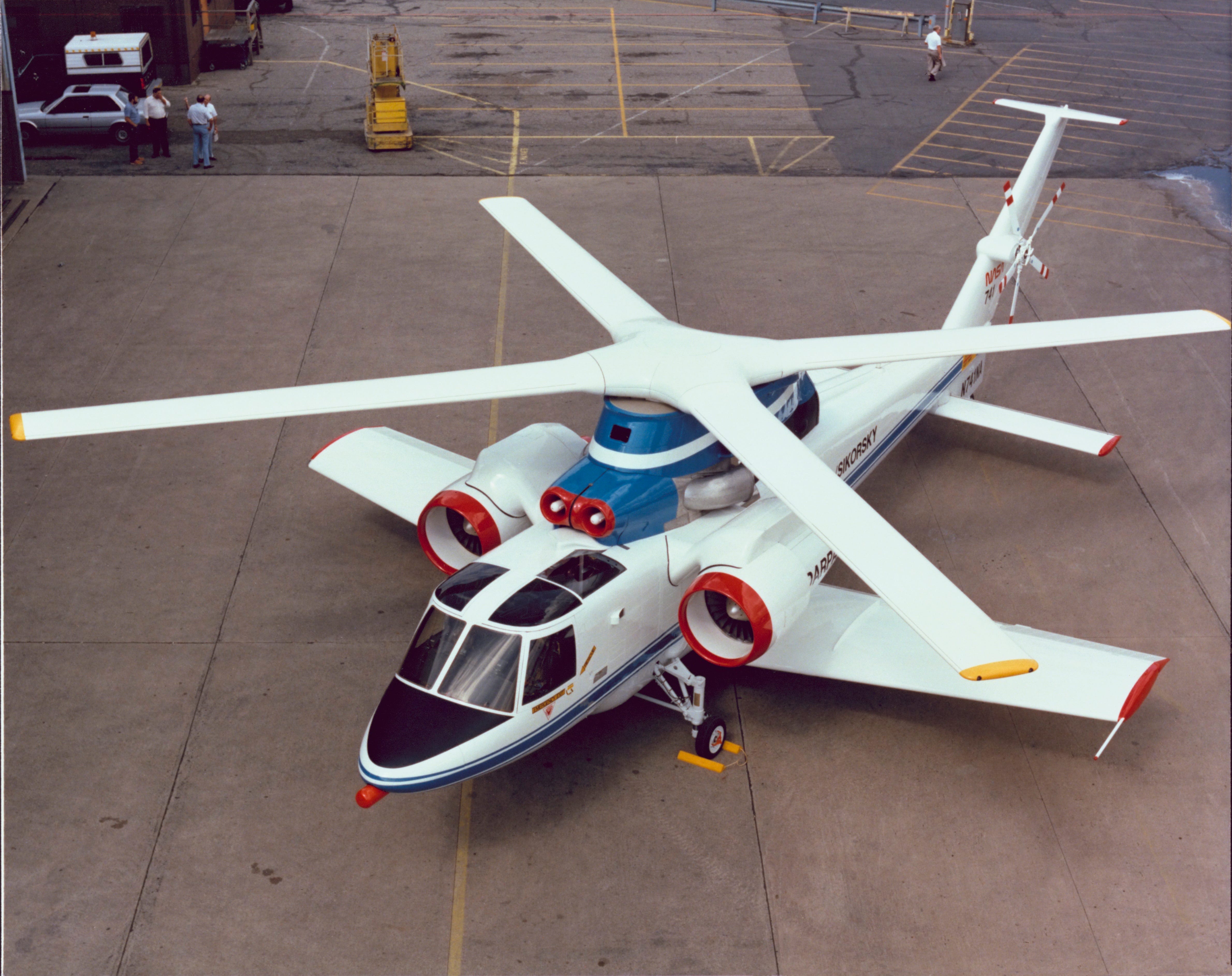
Photo: Sikorsky X-Wing prototype
The idea: stop the rotor.
Not slow it. Stop it completely, lock the blades in a fixed X-shaped position around the hub, and use them as a conventional wing in forward flight. The key enabling technology was circulation control — high-pressure air blown through slots along the trailing edge of each blade, which could manipulate the airflow over the stopped surface to generate lift and control forces without mechanical flaps or moving surfaces. Take off like a helicopter. Accelerate. Transfer lift from the spinning rotor to the stopped blades with blown air filling the gap. Cruise like a fixed-wing aircraft with a single structural system doing both jobs.
On paper, the trade was attractive: no heavy tilt mechanisms, no duplicate rotor systems, no separate lift and propulsion hardware. One airframe, one rotor, two flight regimes.
Development began on a modified S-72 Rotor Systems Research Aircraft, an existing NASA-Army test platform designed for exactly this kind of advanced rotor experiment. The X-Wing configuration was rolled out in August 1986. It was transported to NASA’s Dryden Flight Research Facility at Edwards Air Force Base in September of that year.
Then the testing began — and the gap between the concept and the flight regime became visible.
In November 1987, high-speed taxi tests at Dryden reached 138 knots. On the third run, the vehicle lifted off the runway to 25 feet for approximately 16 seconds. That liftoff was pre-planned as a precursor to first flight in airplane configuration — with the main rotors removed, not spinning and stopping them. By December 1987, initial flights in airplane-only configuration had been completed.
That was the program’s high-water mark.
In January 1988, DARPA ended the contract. The program was cancelled, officially, because of extreme complexity as it was being prepared for flight development testing of the actual X-Wing rotor system. The stopped-rotor transition — the whole point of the program — was never demonstrated in the air. The concept was proven on paper, in computational models, and in ground tests. It was never proven where it mattered.
The Aircraft That Flew the Next Year
Fourteen months after the X-Wing was cancelled, a different aircraft made its first flight.
On March 19, 1989, a Bell-Boeing tiltrotor prototype lifted off at Arlington, Texas in helicopter mode. On September 14 of the same year, the same aircraft completed its first full conversion to fixed-wing flight. The program was called the V-22 Osprey. It had been in joint development since the Joint Advanced Vertical Lift Aircraft program was named in 1982 — the same year Sikorsky received the X-Wing contract.
Both programs were working the same problem at the same time. Both were attacking the helicopter-fixed-wing gap from different angles. Both faced serious technical challenges, schedule pressure, and cost growth. The V-22’s development budget, originally set at $2.5 billion in 1986, had ballooned to a projected $30 billion by 1988 — the same year the X-Wing was cancelled.
Secretary of Defense Dick Cheney tried to cancel the V-22 program repeatedly between 1989 and 1992. Congress overruled him each time.
No one overruled anyone on behalf of the X-Wing.
That asymmetry is the forensic finding. Not the aerodynamics. Not the complexity of stopping a rotor in flight. The X-Wing died and the V-22 survived — barely, repeatedly, by Congressional vote over the objection of a sitting Secretary of Defense — not primarily because one concept was more technically valid than the other. It was because the V-22 had champions and the X-Wing did not.
When I was in aviation R&D long enough to have a view of how this worked, what I observed was consistent: a program that had someone willing to fight for it at budget time — someone with credibility, relationships, and a specific mission argument they would defend in every review — survived things that should have killed it. A program that was technically interesting but had no one who would walk into the room and say “this aircraft and no other one does this specific thing” was running on borrowed time. Eventually the budget cycle would arrive, and there would be nothing between the program and cancellation except the merit of the engineering. Merit alone, in my experience, was rarely enough.
The V-22 had Marine Corps officers who had identified the specific missions it would replace — the CH-46 Sea Knight and CH-53 cargo helicopters — and who would fight for those requirements against every budget challenge. It had a Bell-Boeing industrial team with enough political reach to survive Cheney’s termination attempts through Congressional relationships. It had, in other words, a customer who needed it badly enough to keep it alive through development crashes, cost overruns, and hostile budget reviews across three administrations.
The X-Wing had an interesting concept, a serious engineering team, and a list of potential missions that nobody had elevated to “this aircraft or nothing.”
In the budget room, that is not the same thing.
The Assumption That Was Never Stripped
In this series, each cancelled program carries a signature — a core belief baked in from the beginning that survives design reviews, risk assessments, and test reports without ever being tested against the fundamental question it needs to answer.
For the X-Wing, the unstripped assumption was this: a vehicle that could both hover and cruise efficiently must be valuable, and the need for such a capability is established.
That assumption was treated as obvious. It was never pressed to its first principles.
The questions that should have been stripped down and answered early were not complicated: What specific mission cannot be accomplished with existing assets, or reasonable evolutions of those assets, that only this aircraft could enable? How often will that mission occur? How much better must we perform it to justify the full development and sustainment cost? And — the question beneath the question — who will be in the room when the budget comes calling, willing to make the case that this aircraft is the one?
The answers were available. They were just uncomfortable. The missions on the list — long-range vertical insertion, high-speed search and rescue, shipborne operations with fast ingress and egress — were real. But they were not exclusive. A combination of existing helicopters, tiltrotors, and fixed-wing aircraft, stitched together with doctrine, tankers, and forward staging, could accomplish most of them without the development risk and cost of a new stopped-rotor platform.
There was no mission that the X-Wing could perform and the V-22 could not. There was no operator who stood up and drew that line.
The V-22 had that line drawn for it, loudly, by people with rank and budget relationships. The X-Wing had an interesting concept and a development team that believed in the physics.
Believing in the physics is necessary. In my experience it is rarely sufficient.
What the Pattern Teaches
I have watched enough programs run on bad fuel to recognize what the X-Wing was before I ever looked up the details. The sputtering schedule, the recurring rumor of cancellation, the absence of a clear voice in the customer community saying “we need this aircraft specifically” — those are not failure signs in the engineering. They are failure signs in the mission case. And a mission case that cannot sustain political support through a long development program is not a mission case. It is a hypothesis that has not yet been tested against the only instrument that matters: a budget.
The harder lesson — the one that took me years to see clearly — is that the assumption often feels like a statement of fact. Of course there is a mission for an aircraft that can hover like a helicopter and cruise like a fixed-wing. Of course the military will find uses for a vehicle with that performance envelope. Of course the technology will justify itself once it is mature.
Of course is not an operational requirement. Of course has never survived a budget review. Of course is the fuel that runs out first.
The X-Wing program ended in January 1988. Fourteen months later, the aircraft it was competing against flew for the first time. The V-22 went on to survive crashes, Congressional battles, cost overruns, and a decade of hostile reviews before reaching operational service in 2007. It is still flying today — still controversial, still expensive, still the subject of safety debates — but flying. In combat. On the missions its champions defined and defended.
The X-Wing left behind valuable work in circulation control, high-authority flight control systems for unconventional configurations, and aeroelastic modeling of multi-mode rotor systems. Those contributions migrated into later programs and are still visible in modern research on active flow control and high-speed rotorcraft. The engineering survived.
The program did not. Because in the end, the engineering was not what needed to survive. The mission case was. And the mission case was never built well enough to outlast the budget cycle.
Before you build the next X-Wing, you strip that assumption first.
Not because the concept is wrong. Because “of course” is not a plan.
The Contradiction That Was Never Fully Resolved
There is a deeper observation underneath the mission case and the champion problem.
Going up and going forward are not just different performance requirements. They are a genuine contradiction — in the engineering sense of the word. The physical properties that make a rotor disc excellent at generating vertical lift are precisely the properties that become a liability in forward flight. You cannot optimize fully for both with the same hardware without compromising one or both. Every hybrid aircraft ever built has been, at its core, a negotiated settlement between two physical requirements that do not want to coexist in the same structure.
Compromise is not failure. But compromise is not resolution. There is a difference — visible to anyone who has worked with both — between a design that manages a contradiction and a design that dissolves it. The tiltrotor manages it: carry two complete propulsion modes, pay the weight and mechanical penalty, transition between them on schedule. The X-Wing attempted something more ambitious: make the same hardware serve both regimes without duplication. The dissolution was more elegant in theory. It required the technology to be ready.
In 1988 it was not.
The flight control systems of that era were not yet capable of managing the dynamic coupling between a decelerating rotor, a transitioning lift system, and an aircraft that needed to remain stable through the gap between those two states. The computational power, the sensor fidelity, the actuation speed, the aeroelastic modeling tools — all of it sat at the edge of what was achievable. Which is exactly where you find programs that are both technically fascinating and fatally early.
Technology had not evolved enough to find the beauty in a workable solution.
That observation captures something the program cancellation notices never say plainly: these programs were not wrong about the physics. They were early about the tools. The contradiction between going up and going forward is still being worked. Modern digital flight control architectures, advanced composite structures with properties unavailable in 1988, distributed electric propulsion that decouples lift and thrust in new ways, and sensor fusion capabilities that would have seemed like fantasy to the X-Wing’s control law engineers — all of it is giving the next generation of designers new options for resolving that contradiction rather than negotiating around it.
The X-Wing was a probe at the edge of a solvable problem that the era’s tools could not yet make elegant.
The name will come back. The technology is catching up.
Herbert Roberts, P.E. is a licensed professional engineer with 32 years in aviation research and development across two companies, and has spent eight years analyzing accidents for attorneys under his P.E. license.