


Undisposable Things
You can throw away or recycle most items. But, You can never easily dispose of a large PMC composite resin structure.
That's not a joke. It's an engineering claim, and I'm going to spend the next several minutes proving it, because once you see it you can't unsee it, and it turns out to be a much bigger problem than anyone selling you a boat, a car, or an airplane is willing to say out loud.
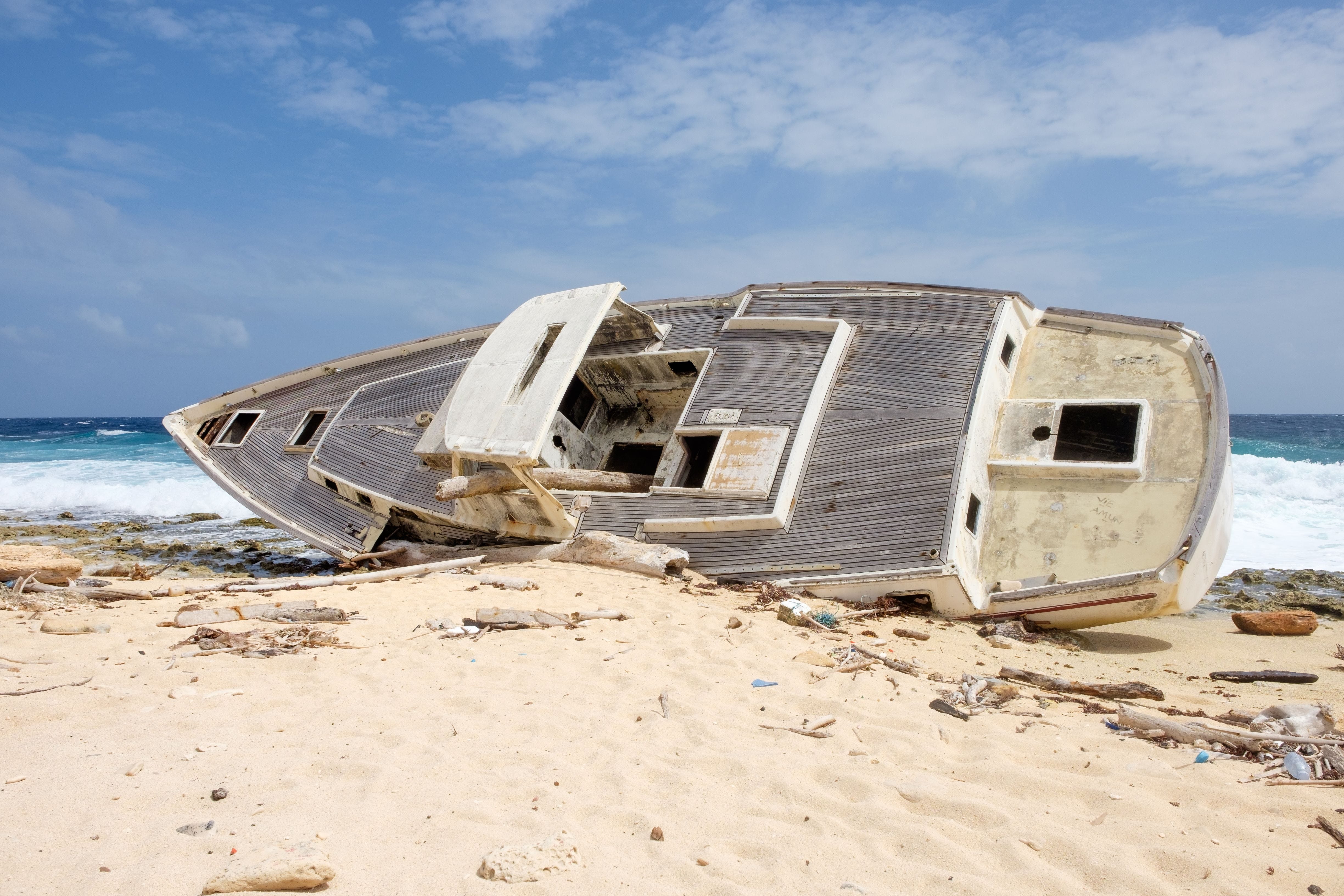
Beached sailboat with PMC hull Royalty free stock photo pexels.com
The scene
A man in Green Cove Springs, Florida, wrote a check for $11,000 last spring to make a sailboat go away. He owned her outright. No loan, no lien, no storm damage. Thirty-six feet of solid hull, a straight mast, a dry bilge. He paid to have her cut up.
Walk that yard on the St. John's River and you'll see forty more waiting their turn. Jack stands settled into the gravel. Sail covers gone chalky and split along the seams. Furling drums seized solid. Boats that crossed the Gulf Stream in their day, standing in a dirt lot with their halyards slapping at nothing. Every one of them was somebody's plan.

Typical sailboat storage yard Royalty free stock photo pexels.com
The dream doesn't usually die in a gale. It dies in a storage yard with an invoice.
The real gatekeepers
Here's what nobody tells you at the boat show, the car lot, or the delivery ceremony: the salesman will give you forty minutes on headroom and horsepower and legroom. He will never once tell you what she'll be worth to the next owner, because by the time that question matters, he's busy selling someone else a different sunset.
Understand who actually decides whether an object gets to keep living in commerce. It isn't the buyer, and it isn't the market in any romantic sense. It's underwriters and loan officers. Insurers have spent the last few years going back through their books on older hulls — rig age, wiring, moisture in the core, grounding history. Boats past twenty or twenty-five years old are seeing premiums jump, upgrades demanded before renewal, and in plenty of cases, coverage declined outright. Marinas won't hand you a slip without liability coverage — $300,000 minimum in most places, $500,000 in some. Most lenders stop writing notes on a hull somewhere past fifteen or twenty years old, at any price.
Follow that chain all the way down. No insurance, no slip, no financing, no financed buyer. What's left is the cash market, and the cash market is small, and it is very particular about what it takes home.
So here's the actual test an object has to fail before it becomes a disposal problem, and it has two gates, not one:
Gate one — repair economics. Does she cost more to fix than she'd be worth fixed? That's a straightforward, honest question, and it applies to any object made of any material.
Gate two — insurability and financeability. Can she get coverage, a slip, a loan to a buyer? This gate has nothing to do with her condition. It's a line drawn by people who have never seen her, based on nothing but a date.
An object only needs to fail one of these gates to become undisposable. And the more interesting failure — the more unfair one — is the boat that passes gate one easily and fails gate two purely on age. A dry bilge and a straight mast don't matter to an underwriter working off a birth year. That's exactly the boat in the yard on the St. John's River, and it's where the real story starts, because up to this point it's just an unfair market. What happens next is chemistry.
Six ways out, all closed
Once a hull fails the insurability gate, here's every path back to value, and here's why each one is closed.
Resale. Already covered — this is the gate that got her here in the first place. Clean Ranger 33s, a 1970s racer-cruiser built by Gary Mole, ask $7,500 to $15,000 today. Not because she's a poor boat. Because the fleet she was built for — Wednesday night racing, handicap classes — thinned out and mostly disappeared, and the cruising buyer who steps below finds a Spartan interior and steps right back off.
Parts-out. This is where the material itself starts working against her. A fiberglass hull is a monolithic bonded structure — hull, deck, stringers, often the interior pan, chemically fused into essentially one part. There's no unbonding a keel stub or reselling a section of hull skin. Cut fiberglass and you have scrap, not a component.
Compare that to a wood hull, which is mechanically fastened, not chemically monolithic. Frames, planks, deck beams, cabin joinery, bronze ports and chainplates — all discrete, all removable with a screwdriver or a saw, all individually salable. A dead wood hull liquidates piece by piece. A dead composite hull does not, with exactly one exception: lead ballast. Many composite sailboats carry an internal or external lead keel — four, five thousand pounds on a boat this size — and lead doesn't degrade with age. It's the one component on a fiberglass hull that behaves like the wood-boat model: separable, valuable regardless of condition, priced by current scrap rates. It's also the heaviest thing on the boat, which tells you something about how little of her total mass actually has a second life.
Grinding to feedstock. Fiberglass dust is a serious industrial hazard — silica and glass fiber particulate requiring respiratory protection and specialized handling, which drives cost well above ordinary demolition. Glass fiber is abrasive; it chews through blades and equipment fast. And the output has no market. Ground fiberglass isn't a feedstock anyone wants — thermoset resin can't be re-melted like a thermoplastic, so it isn't recyclable into new composite at scale, isn't usable fill, isn't compostable. It goes to landfill either way; grinding just makes disposal marginally cheaper per truckload, if that.
The coarsest, cheapest version of this — crushing to roughly one-inch chunks with standard construction-demolition equipment rather than fine-grinding to powder — lands close to ordinary aggregate size and skips the worst of the hazard and equipment-wear cost. But it still has to compete with quarry aggregate, which is dug, crushed, and sorted at massive scale with fully depreciated equipment and sold for a few dollars a ton. Fiberglass chunks carry acquisition cost, breaking cost, crushing cost, abnormal blade wear, contamination sorting, and hauling — a fundamentally different cost structure than geology. And even if the economics worked, the supply doesn't: the backlog of derelict hulls is a fixed stock, not a renewable flow. A single serious processing operation would exhaust the visible national backlog within a year, then sit on idle equipment waiting for boats to individually age into the disposal window, one at a time, decades apart. Quarries work because geology is functionally infinite. Derelict hulls are the opposite — bounded, one-time inventory.
Reforming under heat. This is where the chemistry finally says no outright. Epoxy and polyester resins are thermosets — the cross-linking that cures them is a one-way chemical reaction, not a phase change. Heat cured resin enough to try to soften it and you don't get pliable material, you get thermal degradation: charring, off-gassing, chemical breakdown, well before anything resembling a moldable state. There is no temperature at which cured resin becomes soft and compressible the way a thermoplastic does. It's the same mechanism that makes vulcanized rubber a decades-long disposal headache — sulfur cross-links rubber polymer chains into a permanent structure the same way curing cross-links resin. Once vulcanized, once cured, neither material reverts. The permanence that lets a hull survive a Gulf Stream crossing is the same permanence that makes her impossible to unmake.
Sandwich-panel construction material. On paper, this is the most credible idea on the list — a wood-skin, composite-core sandwich panel, the same skin-and-core logic that already exists in structural insulated panels and engineered lumber. Outer plywood veneer carries the structural load; a chopped-fiberglass core adds dimensional stability, resisting the moisture-driven expansion and contraction that warps wood panels over seasons. Placed at the panel's neutral axis, a resin-encapsulated core that doesn't absorb water would genuinely constrain shrink-and-swell cycling.
It runs into two separate physical walls anyway. A fiberglass hull is a compound-curved shell, curved in more than one axis at once. Cut a section from it and it won't lie flat — thermoset composite doesn't reflow or relax, so forcing it flat cracks the laminate or leaves it stressed. That forces you back to full grinding to get a flat-compatible feedstock, which reintroduces the cost wall from the previous paragraph. And even ground material isn't uniform: builders vary hull thickness deliberately, heavier at the keel and high-stress areas, thinner in the topsides, with local reinforcement around fittings. Every donor hull yields a different, uncontrolled mix of glass-to-resin ratio depending on where on the hull the material came from. A construction material needs a consistent input. This can't reliably provide one.
Reefing. Steel works as an artificial reef because the material behavior is known and stable — steel sinks reliably, corrodes slowly into iron oxide, which is broadly inert, and there's an established federal approval pathway built specifically around steel hulls. Fiberglass fails on two separate points. Foam-cored hulls often won't sink cleanly or stay down — trapped air and closed-cell foam fight submersion, so a hull that won't stay put isn't a reef, it's a hazard. And most reefing programs don't approve fiberglass vessels at all, excluded by category rather than evaluated case by case, because resin and gelcoat leaching don't meet the same stability standard steel does.
And the two fallbacks everyone reaches for when nothing else works, also closed. She won't rot — nothing biological recognizes cross-linked resin or glass fiber as food, so left alone she'll still be substantially a fiberglass hull in two hundred years, just uglier. And she won't burn, not usefully. Glass fiber survives combustion entirely — its melting point is well over 1400°C, far beyond any open burn or ordinary incinerator — and the resin releases dense, toxic smoke rather than combusting clean, which is exactly why burning fiberglass boats is illegal in most jurisdictions.
There is no economics where reimagining an old fiberglass hull works. She won't rot, won't melt, won't grind into anything worth buying, and won't even burn. She's forever waste.
What this doesn't mean
One honest correction, because the claim above is easy to overstate. A repairable thing isn't undisposable — it just hasn't needed disposing of yet.
Fiberglass car bodies are the clean counter-case. Lotus built a reputation on fiberglass monocoque construction for the same reasons boatbuilders liked it — light weight, complex curves out of a mold, no stamped-steel tooling cost. Same resin, same glass, same one-way cure chemistry as any hull. But automotive fiberglass repair is a mature, decades-old industry: panels are more separable than a continuous hull shell, gelcoat repair and panel patching are routine body-shop work, and there's an active resale market that keeps a damaged Lotus in circulation for decades before anyone asks the disposal question at all.
So the claim isn't that composite is worthless. It's narrower and more defensible than that: composite has no exit once repair economics fail or insurability closes — and that's a different day for every object, depending entirely on whether a market still wants her whole.
The category, widened
Once you see the mechanism, it stops being a boat story. Power boats, jet skis, canoes — same laminate, same resin, same six closed gates, at every price point and size class in recreational watercraft. (Aluminum and polyethylene canoes are the honest exception — those materials have real scrap and recycling paths that composite simply doesn't.) Wind turbine blades are already a documented, headline-level version of this same crisis — thousands sitting in landfills today with no melt-down path, arguably the strongest existing real-world proof that this isn't a theoretical problem. FRP pipe and tank liners, skis, snowboards, surfboards — same chemistry, smaller volumes, same dead end.
There's a useful contrast case worth sitting with: scrap tires. Vulcanized rubber shares the identical one-way-cure chemistry — sulfur cross-linking instead of resin cross-linking, same permanence, same refusal to melt back down. Tire stockpiles were once exactly this kind of problem — fire hazard, mosquito breeding ground, visible blight — and they got a real disposal pathway only after forty years of regulatory mandate and subsidized market-building: crumb rubber, rubberized asphalt, playground surfacing, markets that had to be invented and funded into existence because none arose naturally. Composite hasn't even started down that road. No mandate, no funded market, just quiet accumulation in yards like the one on the St. John's River.
The centerpiece: the 787 has nowhere to go
Here's where the stakes stop being local.

Boeing 787 - Composite primary structure Royalty free stock photo pexels.com
Composite primary structure — the 787, the A350 — is carbon-fiber thermoset. Same chemistry as a sailboat hull, same six dead ends, at a scale that makes a stranded Ranger 33 look almost quaint. Roughly half of the 787's airframe by weight is composite, far more than any prior commercial airliner. That's not a hull's worth of cured resin per aircraft. It's tens of thousands of pounds, multiplied across a fleet that will eventually number well over a thousand aircraft.
Aluminum airframes retiring today feed a mature, genuinely profitable melt-down and scrap industry — the boneyards at Pinal Airpark and Mojave have run on exactly that economics for decades, the same mechanism as a steel ship headed for the reef. There is no equivalent pathway waiting for carbon-epoxy primary structure. The first generation of 787s is only now approaching retirement age, and the industry that will need an answer hasn't priced one in yet.
A resin-hulled sailboat and a 787 fuselage are the same chemistry problem at different scales — cure once, stay cured, forever. The boat in the yard on the St. John's River just got there first.
I have a strange vantage point on this one. I built composite aircraft components at y in the mid-1980s, alongside Honda R&D engineers working on what would eventually become the HondaJet program — years before this material was ever primary structure on anything commercial. I watched composites move from racing hulls and boat building into aerospace with almost no knowledge transfer between industries. Nobody carried the material's long-term behavior with them into the new application. We knew how to make it fast and light. Nobody was asking yet what happens to it in sixty years, because in 1985 there was no sixty-year-old carbon-fiber airframe to look at.
There's one now.
The close
She doesn't have to be broken to become undisposable. She just has to fail one of two tests — worth less than she costs to fix, or unwelcome at any price by the people who gate access to buyers. Composite fails the first test rarely. She fails the second test constantly, and once she does, chemistry makes sure there's no way back.
You can re-gift a fruitcake. You can never dispose of a resin structure.
A stranded Ranger 33 eventually gets cut up, hauled, buried — ugly and expensive, but finite. One hull, one yard, one invoice. A 787 doesn't have that ending available to it at scale. None of the six gates open any wider for a fleet. They close the same way. Just multiplied.
A sailboat that won't go away is a curiosity in one marina. A jet fleet that won't go away is a new kind of landscape.
Retirement isn't a sale for a composite airframe. No scrap value, no melt-down recovery — the same six dead ends as the hull, wearing a bigger price tag. It's an expense. Someone — an airline, a lessor, eventually maybe a regulator-mandated fund — has to pay to close her out, exactly the way the man in Green Cove Springs did.
He paid $11,000 to close out a thirty-six-foot hull. Somebody, someday, pays to close out a 787 — because retiring her was never going to be a sale. It was always going to be an invoice.
There is one exit that actually works, and it isn't a disposal pathway at all — it's a different question entirely. A sound hull that fails the insurability gate while passing the repair-economics gate easily isn't structurally worthless. She's just unwelcome in one particular market. Buy her for cash, outside the financing chain that excluded her. Use her fully — she'll do everything she ever did. Then, when it's time to let her go, don't sell her and don't destroy her. Give her to a Sea Scout unit or a sail-training program, an institution that was never screening on resale value in the first place, that wants a boat with deferred maintenance and an outdated interior precisely because rigging repair and engine maintenance are the curriculum, not a defect. She doesn't need to be perfect to be donated. She needs to be exactly what she is — which is, for the first time in this whole story, an asset instead of a liability.
There's no version of that exit built yet for a 787.
Herbert Roberts, P.E. — 30+ years in aviation R&D across two companies. 8+ years analyzing accidents for attorneys under my P.E. license.