


Nobody’s Paying You to Fix Your Fender
The honest economics of the YouTube salvage flip
I once drove a TR-6 into a pole in a parking lot. Someone had painted the pole flat black — not "hard to see," invisible — and I found out later I wasn't the first person it caught. A cracked headlight, a dented fender, and an insurance claim that was entirely mine to carry, even though I was arguably the least responsible person involved. I never found out who painted the pole. There's no witness, no confession, nothing. Just a black pole and a bad night.
Nobody's ever going to pay six figures for that fender. And that's the honest starting point for this article, because that's what almost all car damage actually is: a repair bill, not a story. If you want to see that principle running at industrial scale, watch a YouTube salvage flip channel for twenty minutes.
The business model
The premise is simple and, it turns out, extremely repeatable: buy a wrecked car at salvage auction — Copart, IAAI, insurance total-loss lots — document the entire repair process on camera, sell the finished car, and monetize through ad revenue, sponsorships, and the sale itself. Channels built around this format produce two videos a week showing the actual collision-repair work, and at the end of every project they run the numbers on camera: purchase price, parts, labor hours, sale price, profit.
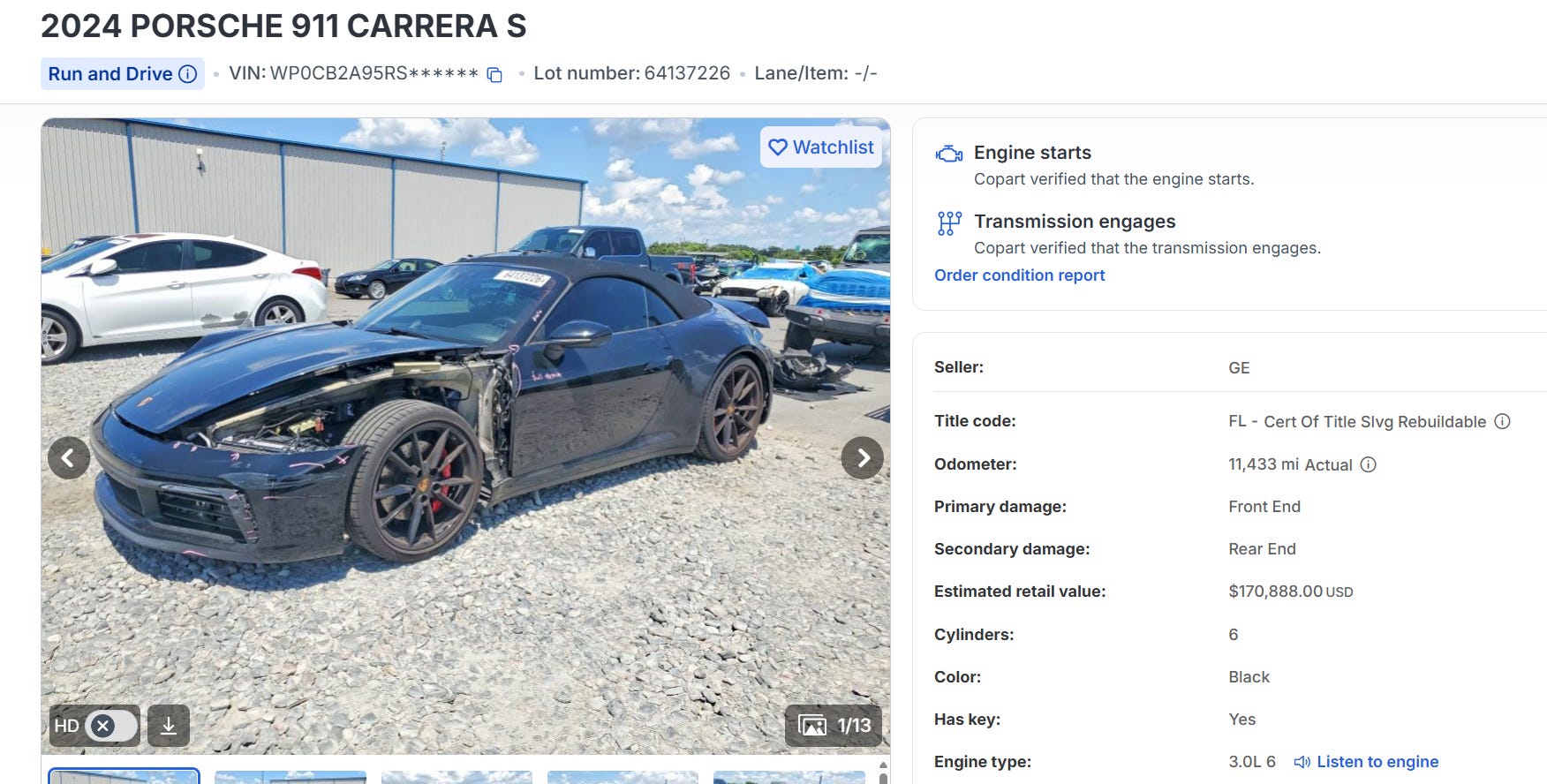
Copart listing of 2024 Porsche 911 Carrera Screen shot of https://www.copart.com/lot/64137226/salvage-2024-porsche-911-carrera-s-fl-orlando-north
It's not romantic. It's a P&L statement with a welder in it. And it works precisely because it's operating in the normal case — a wrecked car with no attached story is worth exactly what it costs to fix it, plus whatever margin the market allows for a clean rebuild. Every project these channels complete is, without anyone framing it this way, a repeated proof that repair beats as-is for ordinary damage. That's not a controversial claim. It's just usually true.
Where it gets interesting
The risk in this business model is quiet and structural, and it's worth naming: these flippers are implicitly betting that every car they buy is an ordinary wreck. Nothing in a Copart listing tells you otherwise — you get damage type, mileage, a VIN, some photos. You don't get "this was owned by someone notable" or "this was involved in a documented event." That information, if it exists at all, lives outside the auction listing entirely, in registries, marque historian circles, or old paperwork nobody thought to check.
Most of the time that doesn't matter, because most wrecked cars really are just wrecked cars. But every so often a flipper could be sitting on something else without knowing it — a chassis with real competition history, a car tied to a name that would matter to the right buyer — and the entire content format pushes toward cutting, welding, and repainting it back to showroom condition as fast as possible. That's the one scenario where the business model would be actively destroying the very thing that made the car worth more than the sum of its repair costs. Nobody's going broke over this. It's just the one blind spot built into an otherwise sound, honestly-run business.
The Model T problem, and the Nash exception
Not every old car behaves the same way once it's fixed, and it's worth knowing which kind you're looking at before you start swinging a wrench.
A driver-quality car from the 1950s sits in the easy case: the roads, fuel, and driving norms it was built for still exist, more or less unchanged. Repair restores real usability, and usability is worth something concrete. The math works the way you'd expect.
A Model T is a different animal entirely, and it's not really about age — it's about whether the world the car was built for still exists. Top speed in the low 40s, mechanical brakes, a transmission nobody alive learned to drive on, built for a road network and traffic environment that no longer exists anywhere.
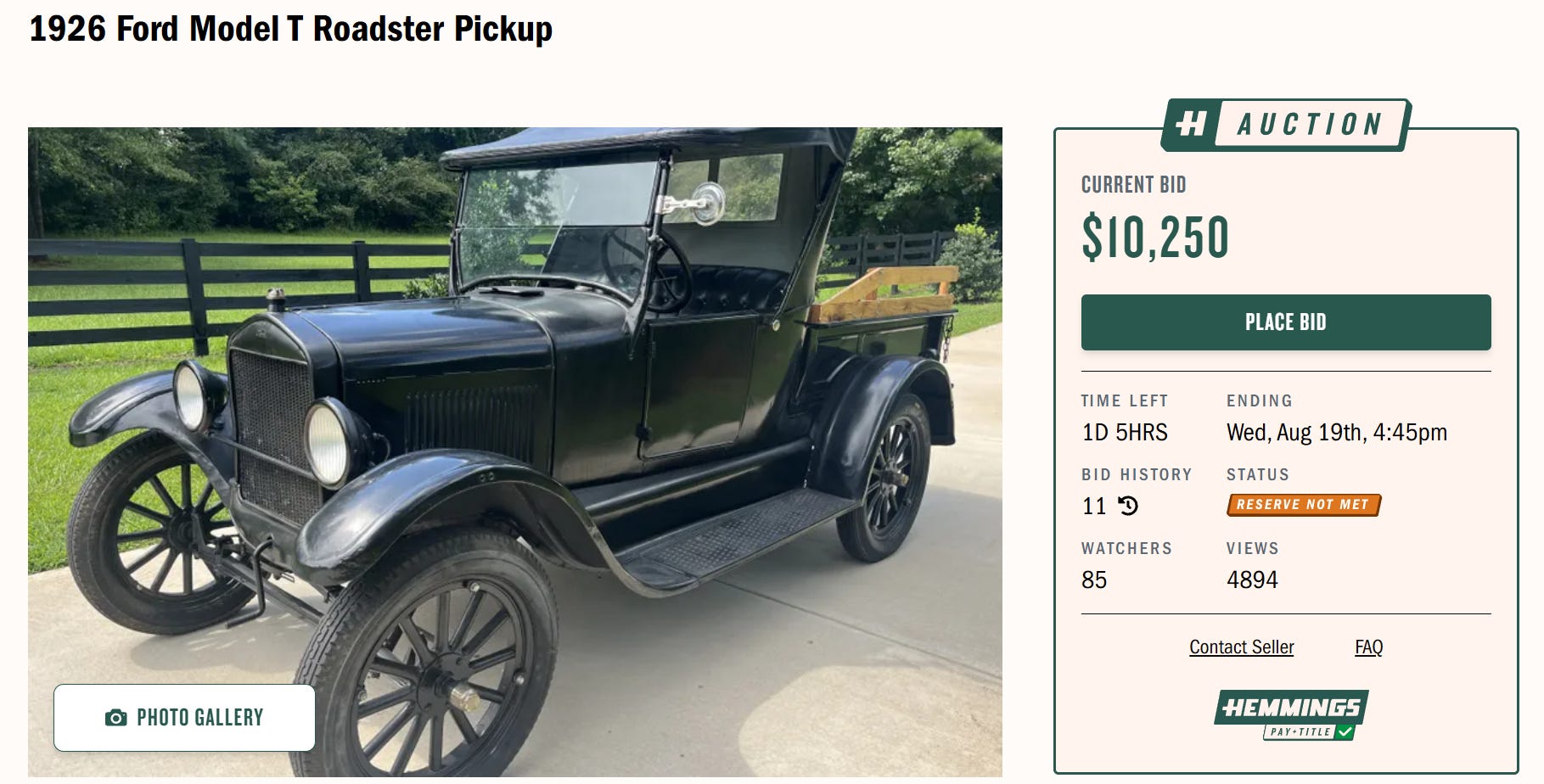
1926 Ford Model T Roadster Pickup Screen shot of https://www.hemmings.com/auction/1926-ford-model-t-tyrone-ga-213545
You can restore it to full mechanical function and it still won't be useful the way a car is useful today. Repair there is closer to museum conservation than to fixing a tool — you're maintaining an artifact, not restoring a use.
A running Nash Metropolitan is the quiet exception that makes the whole comparison useful. It was always small, slow, and a little absurd, even brand new in 1954 — which means the gap between "how it drove then" and "how it drives now" never opened up the way it did for faster, more road-dependent cars. It didn't lose ground to modern traffic because it was never trying to keep pace with modern traffic in the first place.
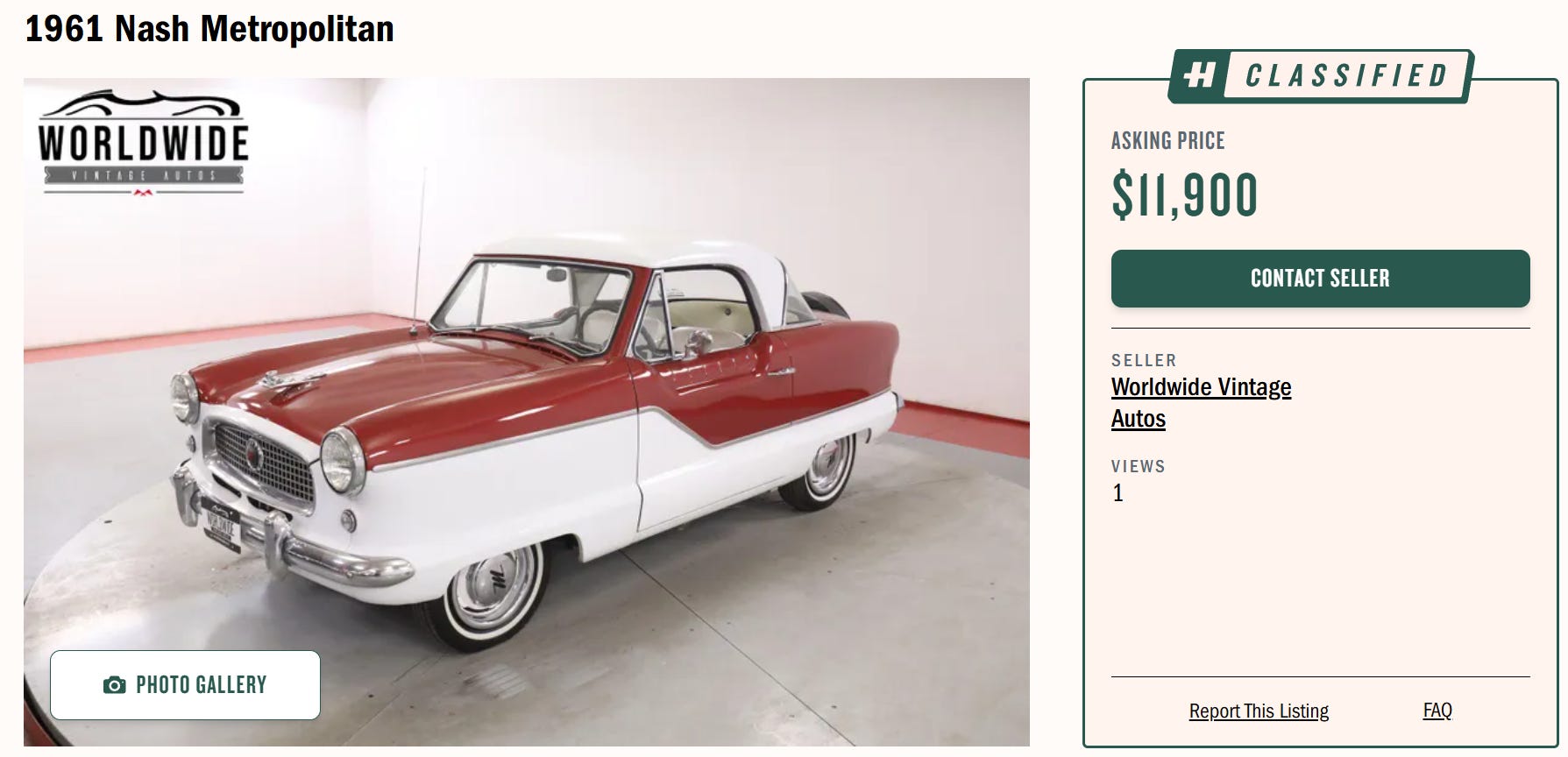
1961 Nash Metropolitan Screen shot of https://www.hemmings.com/classifieds/listing/1961-nash-metropolitan-denver-co-2961237
Repair on a Metropolitan buys back real, usable function, close to dollar for dollar, plus a rarity premium most buyers are happy to pay on top.
Three cars, three different answers to "is repair worth it," and none of it depends on how old the car is. It depends on whether the operating context survived alongside the metal.
The honest close
Somebody, somewhere, will eventually buy a wrecked exotic with a real story attached and repair it anyway, without knowing what they had. That's a genuine risk in an otherwise sound business, and it's worth a line of caution for anyone buying salvage sight-unseen.
But that's not going to be most cars, and it was never going to be my TR-6. No famous driver, no documented event, no witness to a pole nobody can identify.
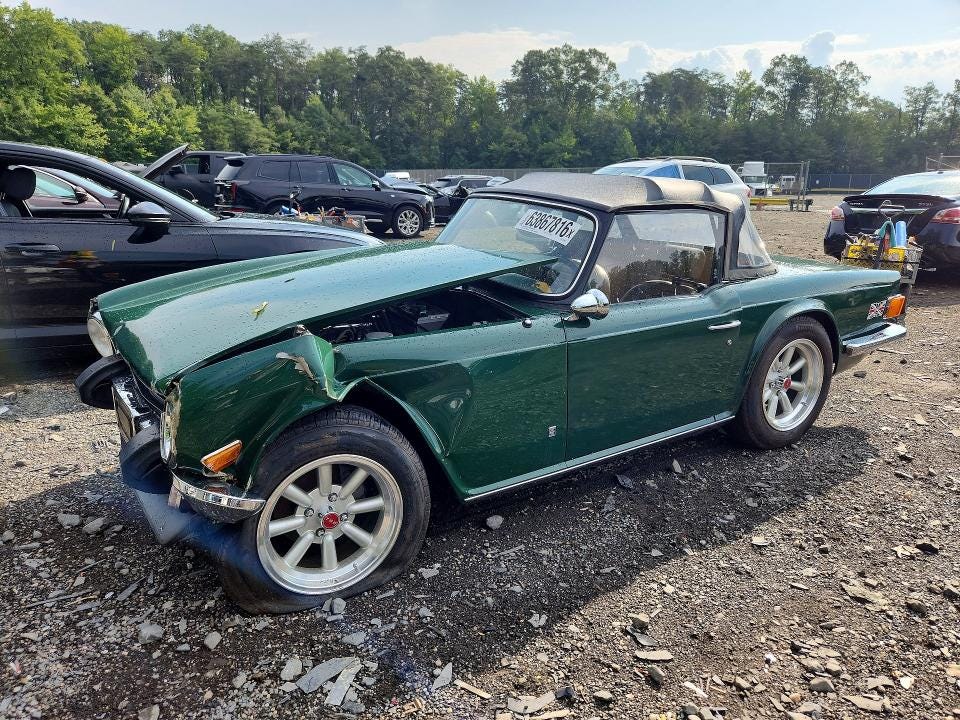
1976 Triumph TR-6 Screen shot of https://classics.autotrader.com/classic-cars/1972/triumph/tr6/102654620 - (Not mine, but similar)
Just a fender, a claim number, and a repair estimate — the ordinary case, playing out the ordinary way, the way it does for almost every car that's ever been wrecked. Fix it. That's not a failure of the story. That was always the right answer.
Herbert Roberts, P.E. — 30+ years in aviation R&D across two companies. 8+ years analyzing accidents for attorneys under my P.E. license.
Just wondering, in Germany is there a market for buying a Porsche or Mercedes that is da.aged a d repairing it to use it resell? I recall a lot of safety inspections on our VW years ago. I would think that there may be restrictions on fix and resell based on the inspection requirements.
Funny you include a Nash Metropolitan. A local TV reporter a few decades ago did travel segments advertised as places you could do on a single tank of gas. The car he always used was a Metropolitan!